
Beijing, China – China’s leaders on Monday wrapped up a week-long key conclave at which they admitted more was needed to revive a sluggish economy battered by an ailing housing market, poor domestic demand and record-high youth unemployment.
Top officials have been upfront about the myriad challenges China is facing, admitting that a modest five percent growth goal will not be easy and that “hidden risks” are dragging the economy down. But they have supplied few details about how they plan to tackle the problems.
Officials have also moved to strengthen powers to deal with threats to their rule and tightened a veil of secrecy around policymaking, scrapping a traditional annual press conference and vowing to include national security provisions in a raft of new laws.
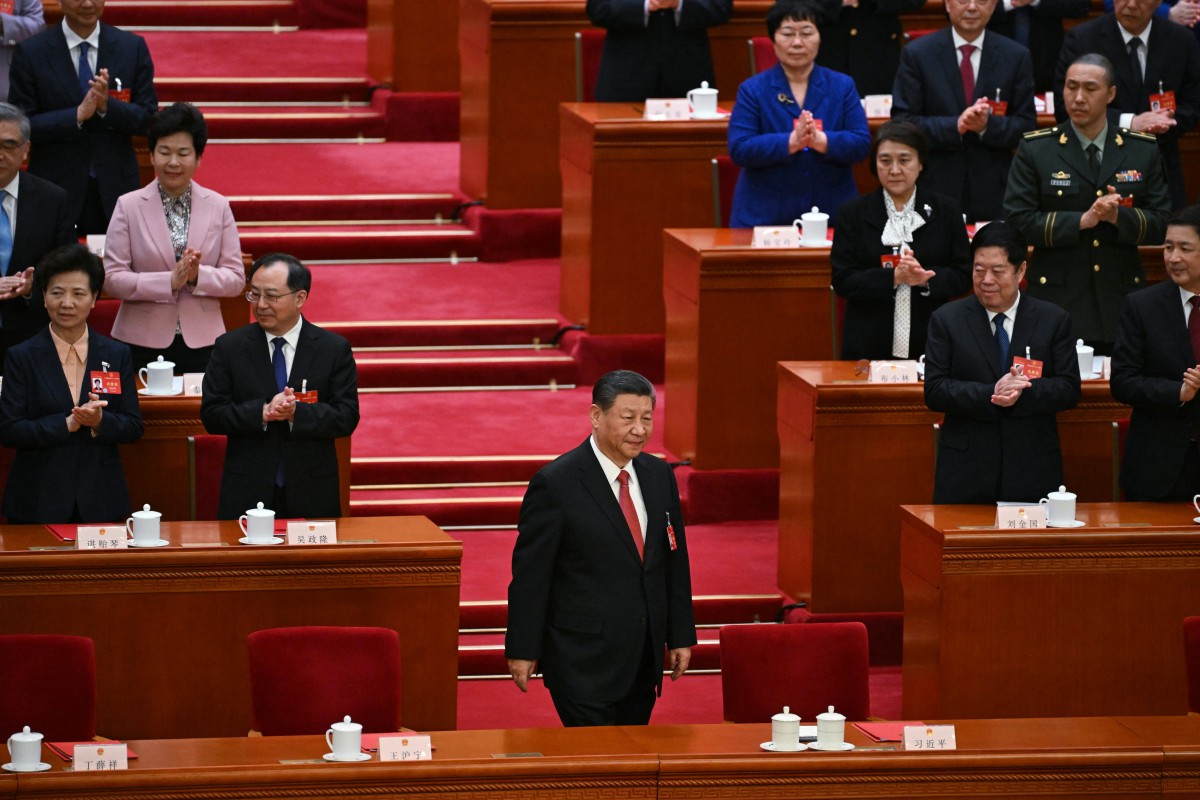
Delegates to the National People’s Congress (NPC), China’s parliament, including leader Xi Jinping, gathered at Beijing’s Great Hall of the People to rubber-stamp legislation at 3:00 pm local time (0700 GMT) as the conclave came to an end.
Among the pieces of legislation approved was a revision to the Organic Law of the State Council, China’s cabinet, which state media has said will aim to deepen the “leadership” of the ruling Communist Party over the government.
Delegates also approved the country’s state budget and the national economic and social development plan for 2024.
Only a handful of the body’s almost 3,000 delegates voted against any of the motions.
Top lawmaker Zhao Leji declared the annual meeting closed.
– ‘Go forward bravely’ –
Speaking to media, representatives were uniform in their praise for the government.
Li Dexiang, representing southwestern Guizhou province, told AFP he believed the “government has a good grasp of reality”.
Delegate from eastern Jiangsu province Lyu Caixia said the experience of the parliamentary meeting “pushes one to go forward bravely”.
“We are accelerating high quality development… all the way to the highest levels (of government),” she added.
And Ling Youshi, a delegate from the semi-autonomous city of Hong Kong, said she had experienced the “rigor of deliberating legislation” during her time at the so-called “Two Sessions”.
The tightly choreographed event capped a week of high-level meetings that have been dominated by the economy, which last year posted some of its slowest growth in years.
On Saturday, ministers pledged to do more to boost employment and stabilize the country’s troubled property market.
“Workers face some challenges and problems in employment, and more effort needs to be made to stabilize employment,” Wang Xiaoping, minister of human resources and social security, told a press conference.
Housing minister Ni Hong added that fixing the property market — which long accounted for around a quarter of China’s economy — remained “very difficult”.
– More action needed –
Despite official pledges of fresh support, analysts say they are yet to see the kinds of big-ticket bailouts the flagging economy needs if it is to rebound.
“Reviving the economy requires boosting household wealth and income, something China’s leaders clearly aren’t yet ready to do,” said analysts at Trivium, a research firm specializing in China, in a note.
And throughout the “Two Sessions”, officials have appeared reluctant to face questioning about the economic headwinds China is confronting.
Last week, they broke a decades-long tradition by scrapping a press conference by the premier — long a rare chance for foreign media to question the country’s number-two official.
The topic was swiftly removed from search results on Chinese social media giant Weibo, as was a hashtag declaring “middle-class children have no future”.
Lawmakers have also vowed to adopt wide-ranging security laws in 2024 to “resolutely safeguard” the country’s sovereignty, further expanding the Communist Party’s powers to punish threats to its rule.