

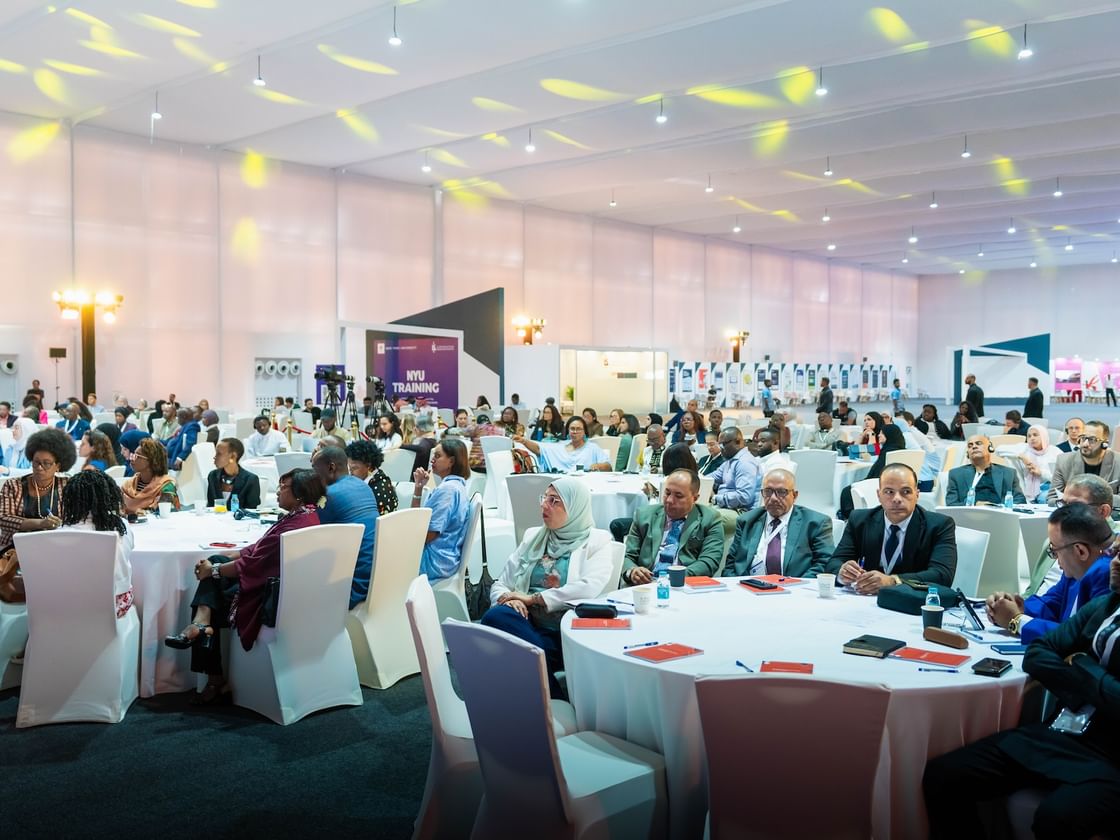

Arabic publishing has significant room to expand internationally, with audiobooks, translation and digital marketing emerging as key growth opportunities, industry executives said at the 15th Sharjah NYU SPS Executive Publishing Programme.
The event, organised by the Sharjah Book Authority (SBA) in collaboration with New York University’s School of Professional Studies (SPS), brought together 200 publishers for discussions and workshops on reaching new audiences through audio, video, social media and international rights exchanges.
Held at Expo Centre Sharjah under the theme ‘Seeking New Audiences: Connecting and Communicating on an International Scale’, the programme featured seven speakers examining changes in publishing markets and opportunities for Arabic content to reach readers and listeners worldwide.
Mansour Al-Hassani, director of publishing services at SBA, said publishers needed to look beyond producing and distributing books as reading habits and industry business models evolve.
Publishing now encompasses content development, rights management, marketing and international expansion, he said, adding that publishers needed new skills and approaches to remain competitive.
A major focus was the potential of Arabic audiobooks, with speakers highlighting both the size of the language market and the limited availability of titles.
Iria Alvarez, vice president of global audio strategy at Penguin Random House, said publishers could learn from audiobook markets in Brazil and Spanish-speaking countries while developing strategies suited to the Arab world’s linguistic and cultural diversity.
Arabic publishers should secure audio rights early, expand their catalogues and invest in professional narration, she said. Artificial intelligence could improve production efficiency, but storytelling quality and an understanding of listener preferences would remain central to building audiences.
The scale of the opportunity was underscored by Ali Abdel-Moneim, CEO of Arabookverse, who said only 14,000 Arabic audiobook titles were available to approximately 470 million Arabic speakers.
The regional audiobook market grew by 165% in 2025, while around 70% of listeners had not previously developed a reading habit, suggesting audio formats could introduce books to audiences beyond conventional readers, he said.
Ahmed Rewihel, chief operating officer of Arabookverse, highlighted differences between consumption and revenue across regional markets.
The Gulf generates 61% of audiobook revenue but accounts for 26% of listening, while Egypt, North Africa and the Levant represent 54% of consumption but only 24% of revenue, he said.
These differences make local market knowledge important for publishers seeking to expand, particularly as international platforms increase their presence in the region. Existing print titles could also find new audiences through audio adaptations and audio-first publishing.
Beyond digital formats, the programme examined how Arabic literary works could travel internationally without losing their cultural identity.
Tamer Said, director of the Sharjah Literary Agency, said publishers needed to adapt book covers, marketing and positioning to suit international markets while retaining the distinctive cultural contexts of the original stories.
Kelly Farber, a global literary scout, discussed routes into international markets through rights licensing, translation, literary agents, book fairs and distribution partnerships. She also highlighted opportunities to extend literary properties into film and streaming.
Digital marketing formed another strand of the programme, with Lauren Hesse, senior director of social media at Little, Brown and Company, part of Hachette Book Group US, examining how YouTube, TikTok and short-form video could turn audience awareness into book sales.
The programme concluded with a session by Dr Mahmoud Al-Rajabi, chair of the Department of Journalism and Digital Media and associate professor of digital media at East University in Jordan, on the use of artificial intelligence in manuscript evaluation.
The discussion covered AI-assisted assessment, prompt development and evaluation reports, while examining the limitations of using automated tools in editorial decision-making.