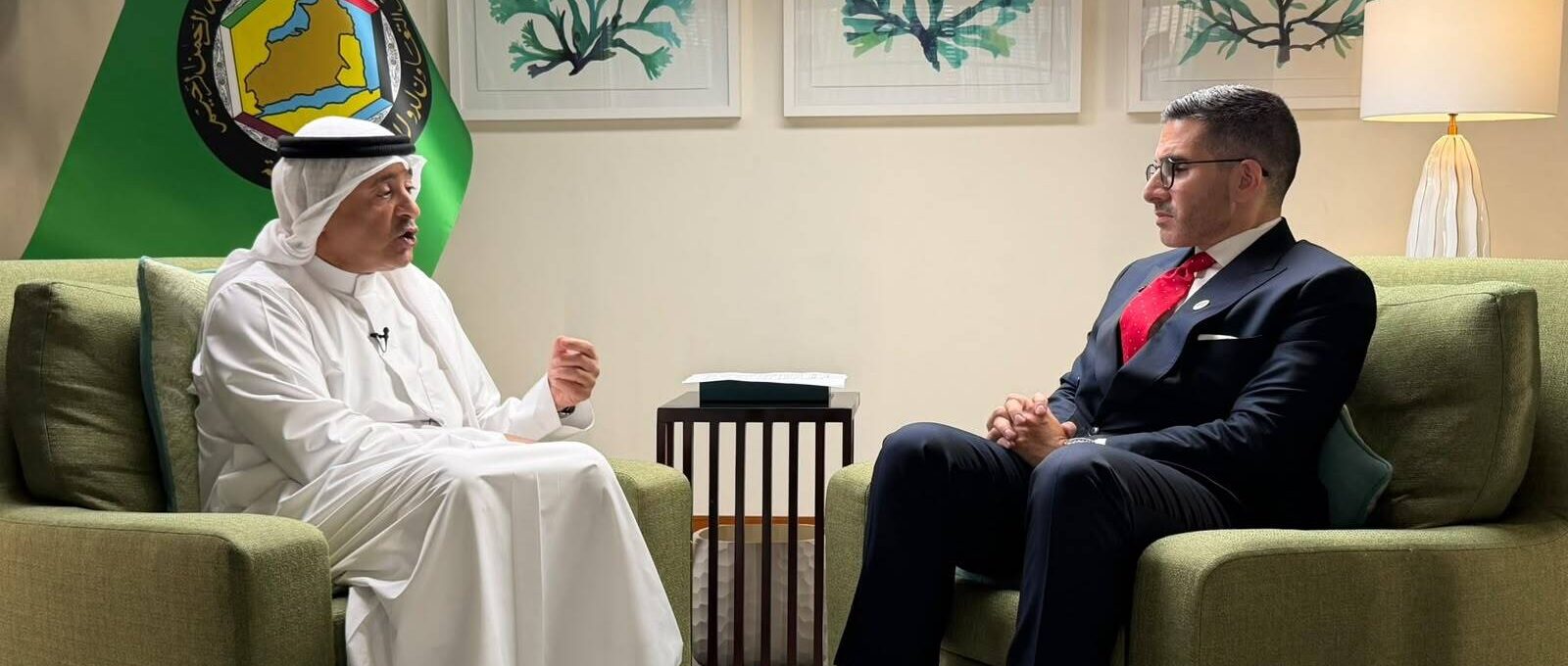

Gulf Cooperation Council (GCC) Secretary-General Jasem Mohamed Al-Budaiwi said on Friday that the start of a process to waive Schengen visa requirements for citizens of five Gulf states is “very close”, with an announcement expected at the EU-GCC summit in Riyadh on 24 October.
Speaking to the Arab Views podcast, hosted by Faisal J. Abbas, Al-Budaiwi said visa-free travel would apply to Saudi, Qatari, Omani, Bahraini and Kuwaiti citizens. Only the United Arab Emirates currently has a visa-free arrangement with the European Union for short stays in the Schengen Area.
“I will give you something exclusive. We are very close to reaching the beginning of the process to waive the Schengen visa for GCC citizens, for the five countries, the five remaining countries,” he said. “So, inshallah, in that summit, you will hear something positive about that.”
He cautioned that the process would not move at the same pace everywhere. Applications would be reviewed country by country and could be completed faster in some states than in others, he said.
The interview was recorded in Manama on the sidelines of the “Made in GCC 2026” Forum and Exhibition.
Trade deal with EU still elusive
The summit is unlikely to produce a similar announcement on a GCC-EU free trade agreement (FTA), comparable to the one the bloc signed with the United Kingdom earlier this year.
“Historically, we’ve entered into negotiations with them for many years and we never reached, unfortunately, a conclusion,” Al-Budaiwi said. He said economies had changed since then, with AI, the digital economy and services now part of the picture, so “we have to start something new with the EU”.
He said the EU side was insisting on adding aspects to the FTA, including human rights clauses, which the GCC believes should be removed. “Not really political,” he said when asked whether the demands were political, but “something like human rights and other issues which have nothing to do with” a trade deal. He said the Gulf bloc’s other FTAs do not include such subjects.
Al-Budaiwi said two EU events were due before the summit, including a 16 October joint meeting in Brussels between the speakers of the six GCC parliaments and the speaker of the European Parliament.
UK deal and Asian talks
Al-Budaiwi said the UK agreement would give GCC goods tariff-free access to the British market from day one once the six Gulf states and the UK ratify it. UK goods would enter Gulf markets in phases of three, five or even 10 years, he said.
He said the bloc was also pursuing deals elsewhere. Talks with Indonesia are “almost 80, 85%” complete, he said, with a first round of negotiations with India due in December and with Malaysia in January.
A GCC visa and a defence debate
On a unified Gulf visa, Al-Budaiwi said the plan was a decision of the bloc’s Supreme Council, not just a discussion. “We are very, very close,” he said, adding he was optimistic an announcement could come soon.
He rejected the view, voiced in some international media, that the GCC is divided. The bloc is “more unified than ever”, he said, citing the attacks by Iran since 28 February, which followed Operation Epic Fury, and a UN Security Council resolution passed unanimously.
Asked about criticism of an April summit in Jeddah, which some leaders did not attend, he said the GCC had held that extraordinary summit on 28 April, three extraordinary ministerial meetings and hundreds of committee meetings. Leaders tasked the secretariat with advancing logistics coordination, water and electricity grid connectivity, strategic storage and the GCC railway project, he said. He said the electricity grid was “working 100%”.
He said Bahrain, Qatar and Kuwait, which rely on a single sea passage, received major help from the UAE, Saudi Arabia and Oman, which opened ports and airports and eased rules for trucks.
Asked why the Peninsula Shield force was not activated as a collective defence force, Al-Budaiwi said that was a military decision based on need. Any member can request it, he said, and it has been activated twice: when Iraq invaded Kuwait and during the unrest in Bahrain in 2011 or 2012, by his recollection.
Each country fought the “Iranian threat” on a national track and through coordination with the GCC, with some states sending personnel, ammunition or missile systems to others, he said.
Hormuz, accountability and Iran
Asked whether the GCC had a unified position against tolls in the Strait of Hormuz, Al-Budaiwi said the Gulf states’ position was to follow international law and maritime treaties. When it was put to him that Iran does not follow international law, he said Iranian behaviour “does not comply whatsoever with the international community”.
On seeking reparations from Iran, he said each affected country had a “basic right” to pursue compensation, whether jointly or individually. The GCC had not decided on a joint approach, he said.
He declined to comment on a meeting between the GCC and Iran in Oman that had been postponed last month, saying it was not organised by the GCC.
Looking a year ahead, Al-Budaiwi said he was optimistic the Gulf and Iran could “sit on one table” and discuss issues that would benefit the peoples of both sides. “They are our neighbor. We are their neighbors. We are next to each other until the end of all days,” he said, adding that the two sides needed to respect each other, follow international law, avoid interfering in each other’s affairs and “send positive messages to each other”.
He said the GCC’s six foreign ministers had conveyed that message, along with a wish to cooperate in ways that would benefit the Iranian people, at a meeting with Iran’s foreign minister in October 2024.
Al-Budaiwi pointed to economic figures to make his case. Bahrain, Qatar and Kuwait, the three smallest GCC states by size and population, have a combined population of about 9 million and a combined GDP of $470 billion, he said. Iran has 92 million people and vast natural resources, but a GDP of about $360 billion, he said. “Look at the GDP, look what we have done with our own country,” he said, noting that the three states’ population is roughly 10 percent of Iran’s.
‘Helping Yemenis return to negotiations’
On Yemen, Al-Budaiwi said all GCC states had invested political will in helping Yemenis return to negotiations. He said the GCC had hosted Yemeni parties at the secretariat, and Saudi Arabia and Oman played a major role in bringing the sides together. A roadmap for resuming the peace process was reached with the UN envoy, he said, but the Houthis’ position was holding it back.
Asked whether any Gulf state or the GCC itself was mediating, he said he could not provide that information.