
Dubai, UAE — The Middle East and North Africa region recorded an overall decline in energy transition performance in 2026, as weakening transition readiness offset continued gains in energy equity, according to the World Economic Forum’s Energy Transition Index 2026, published Thursday in collaboration with Accenture.
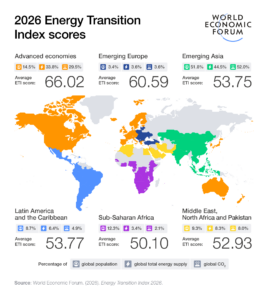
The region’s score fell 0.9% on the year, driven primarily by falls in regulation and political commitment and in infrastructure performance, the report said. The Middle East, North Africa, and Pakistan grouping posted an average score of 52.93, with transition readiness within the group declining 1.82% even as system performance rose 0.7%.
Hormuz Disruption Intensifies Pressure
The report said disruption to energy flows through the Strait of Hormuz had intensified existing pressures on regional and global energy systems, reinforcing energy security as a defining feature of the transition. The chokepoint carries roughly a quarter of global seaborne oil trade and around one-fifth of global liquefied natural gas trade, according to the report.
The disruption triggered the International Energy Agency’s largest coordinated emergency reserve release in history, the report said, pushing Brent crude above $100 a barrel — matching 2022 peak levels — and sending gas prices sharply higher, particularly in Europe. U.S. gasoline prices rose 50% in April since the conflict’s start, while European diesel and natural gas prices surged by up to 60% by March, the report said, citing external data.
The report outlined a phased impact: short-term volatility in wholesale gas prices, net fuel imports and import diversification within the first two months; medium-term pressure on household and industrial electricity prices, energy subsidies and renewable investment over three to six months; and potential long-term structural shifts toward diversified energy supply and renewable capacity build-out beyond six months.
Import-dependent emerging economies were particularly affected, the report said, facing harder trade-offs between energy access, affordability and transition investment than wealthier nations able to draw on strategic reserves or fiscal cushioning.
Saudi Arabia Stands Out
Saudi Arabia bucked the regional trend, recording strong year-on-year improvements in transition readiness driven by stronger financial backing, accelerated renewable deployment and investment in large-scale battery storage, the report said. The kingdom’s overall ETI score rose 1.5% to 57.4, with transition readiness climbing 5.3% even as system performance dipped 0.6%.
Renewable energy investment in Saudi Arabia rose from $6.6 billion in 2024 to $11.9 billion in 2025, the report said, driven by the National Renewable Energy Program, under which 20.6 gigawatts had been tendered by 2025, achieving what the report described as world-leading low solar tariffs through competitive auctions. Finance and investment improved 28.4% year-on-year, the report’s country profile showed.
UAE Retains Regional Lead
The United Arab Emirates remained the highest-ranked economy in the region, the report said, continuing to perform strongly on energy equity, regulation and political commitment. The UAE ranked 49th globally with an overall score of 59.1, comprising a system performance score of 62.9 and a transition readiness score of 53.6, according to the report’s ranking table.
The region continued to perform strongly on energy equity overall, the report said, supported by widespread energy access and relatively favorable affordability conditions. The Middle East, North Africa and Pakistan grouping recorded the highest average equity score of any region, at 74.73, according to the report’s regional performance snapshot.
Fossil Fuel Dependence Persists
The report said the region continues to invest heavily in the energy transition, but that progress remains uneven as fossil fuel dependence, weaker readiness and limited system flexibility continue to constrain broader transformation.
Declines in countries including Tunisia, Jordan, Lebanon, Egypt and Pakistan largely reflected macroeconomic pressures, institutional constraints and delays in policy implementation rather than a reversal of long-term ambitions, the report said. In several cases, fiscal stress and energy security concerns slowed reform momentum and weakened policy consistency, it added.
Global Picture: Readiness Declines for First Time in a Decade
Globally, the report found that despite record clean-energy investment, transition readiness declined for the first time in more than a decade. The overall global ETI score was roughly flat, rising just 0.03%, as a 0.43% gain in system performance was offset by a 0.76% decline in transition readiness.
Global energy investment reached $3.3 trillion in 2025, including $2.3 trillion in clean energy, the report said. Renewables and nuclear generated 42% of global electricity, and renewable capacity increased by nearly 800 gigawatts. Yet finance and investment conditions fell 1.8%, the sharpest decline among readiness enablers, as renewable energy investment dropped 9.5% even as total clean energy spending hit a record.
Regulation and political commitment declined 1.2%, driven by rising policy instability in countries including the United States, the United Kingdom and the Netherlands, though India strengthened its support, the report said. Innovation fell 1.1%, and infrastructure declined slightly by 0.2%, with more than 2,500 gigawatts of projects stalled in grid connection queues worldwide, according to the report. Education and human capital were the only readiness dimensions to improve, rising 2.0%.
Security the Only System Performance Dimension to Decline
System performance improved overall, driven by gains in equity (1.6%) and sustainability (0.6%), but security declined 0.9%, making it the only system performance dimension to deteriorate, the report said. The decline was driven primarily by weaker reliability and supply conditions, with 74 economies recording deterioration in security scores.
Energy efficiency improved in 92 economies, the report said. Demand growth continued to accelerate, driven by electrification, cooling, digital infrastructure, AI-enabled data centers and economic growth, with global AI investment reaching $1.5 trillion in 2025.
Sweden Leads Global Rankings for Third Year
Sweden led the 2026 rankings for the third consecutive year, with Nordic and European economies anchoring the top 20, the report said. Finland and Denmark held second and third place, respectively. China ranked 14th, Brazil 17th, the United States 19th, with Germany 9th, France 10th and the United Kingdom 11th also among the top 20.
Singapore was among the biggest climbers, rising 10 places in the index, driven by new regulations and stronger political commitment, the report said. Sub-Saharan Africa recorded the strongest regional gains, while Latin America weakened amid declining transition readiness.
Three priorities will define the next phase of the transition, the report said: strengthening security, affordability and resilience; unblocking delivery by expanding infrastructure; and increasing investability through stable policy, credible regulation and better risk-sharing.