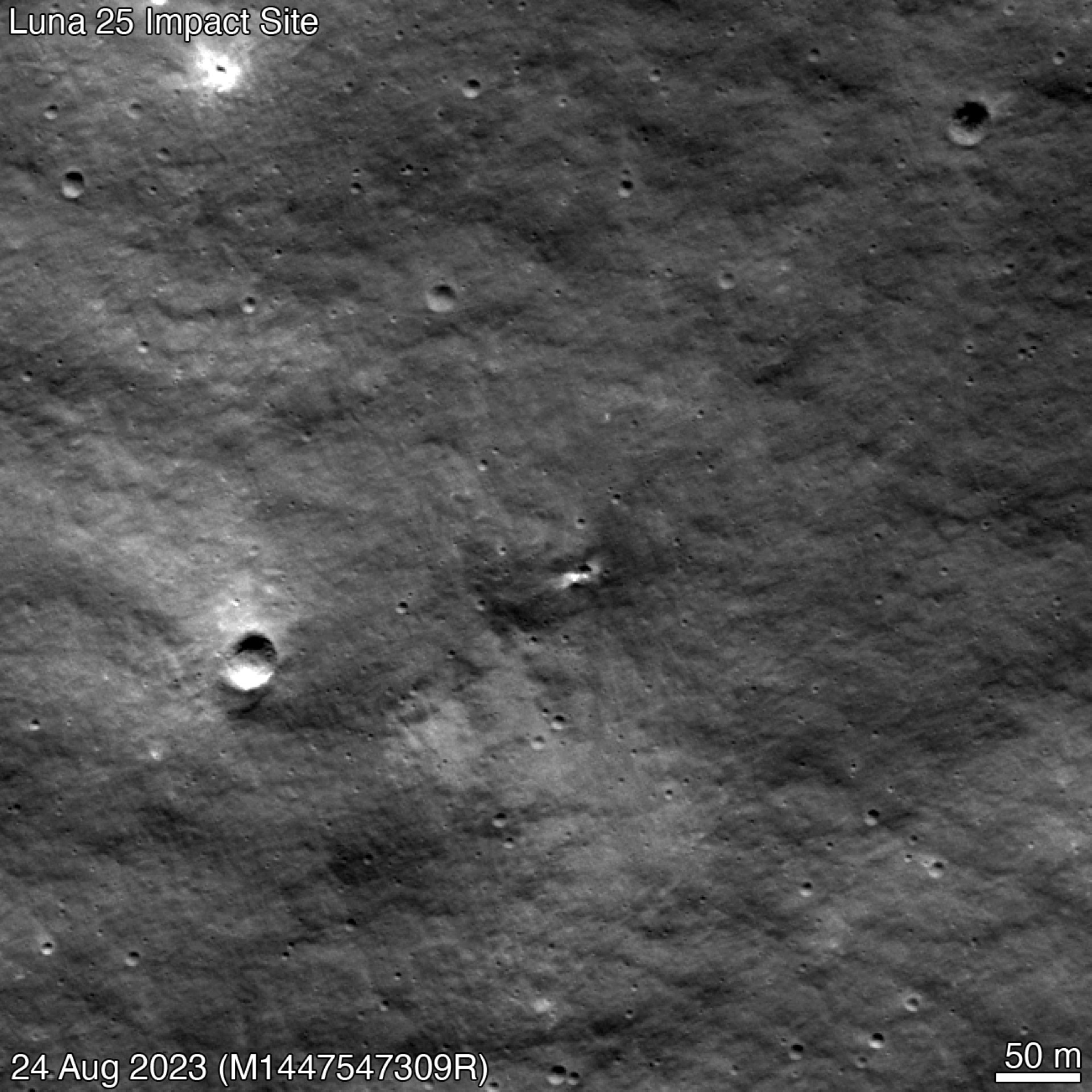

Washington, United States – NASA has spotted a small new crater on the Moon that was likely caused by a Russian probe crash landing on the surface around two weeks ago.
The finding was made by the Lunar Reconnaissance Orbiter (LRO) by comparing before and after images of the estimated impact point, provided by Russian space agency Roscosmos.
The Luna-25 probe crashed on August 19, scuppering Russia’s hopes of reviving its long dormant Moon program with the first ever soft landing on the lunar south pole.
That accolade went instead to India, which successfully landed its Chandrayaan-3 mission on August 23 and is currently exploring the polar region with its Pragyan rover.
LRO, which has been in orbit over the Moon since 2009, took its most recent “before” image in June 2022. This was compared to an image taken on August 24, 2023.
“Since this new crater is close to the Luna 25 estimated impact point, the LRO team concludes it is likely to be from that mission, rather than a natural impactor,” a NASA statement said.
The new crater is about 10 meters (32 feet) in diameter, some 400 kilometers (250 miles) short of Luna-25’s intended landing point.
NASA also plans to return to the Moon under its Artemis program, with the goal of building a sustained presence. Ice deposits could be exploited to support human habitats or broken down into hydrogen and oxygen for use as rocket fuel.