INSEAD Day 4 - 728x90

Samsung biggest chip investor

The tech giant invested nearly $59.2bn in 2025.

flynas to set up new hub

Five destinations in first phase of operations.

AD Ports Group acquires CLI

CLI is Brazilian agri-bulk terminal operator.

$1.59bn Makkah project awarded

A consortium will develop two districts in the Holy City.

2PointZero posts profit surge

Growth driven by merger consolidation.

Slower GCC growth expected in 2023

  • Maroun Kairouz, Director for the Middle East and North Africa (MENA) at the World Economic Forum says GCC countries would be the least affected by the recession.
  • Easing of pandemic restrictions, and positive developments in the hydrocarbon market drove strong recoveries in 2021 and 2022 across the GCC, World Bank says.

Dubai, UAE—The global economy faces another period of uncertainty in 2023, with many countries expected to face recessions and continued inflation putting pressure on both government and household budgets. Some Middle Eastern countries are experiencing the full force of these headwinds. Nonetheless, the GCC appears to be an island of calm in this storm, as it appears to be bucking the trends of the predicted global recession, which is expected to hit at least a third of the world’s economies in 2023, according to the IMF. TRENDS takes a look at the country-wise economic outlook of the GCC states:
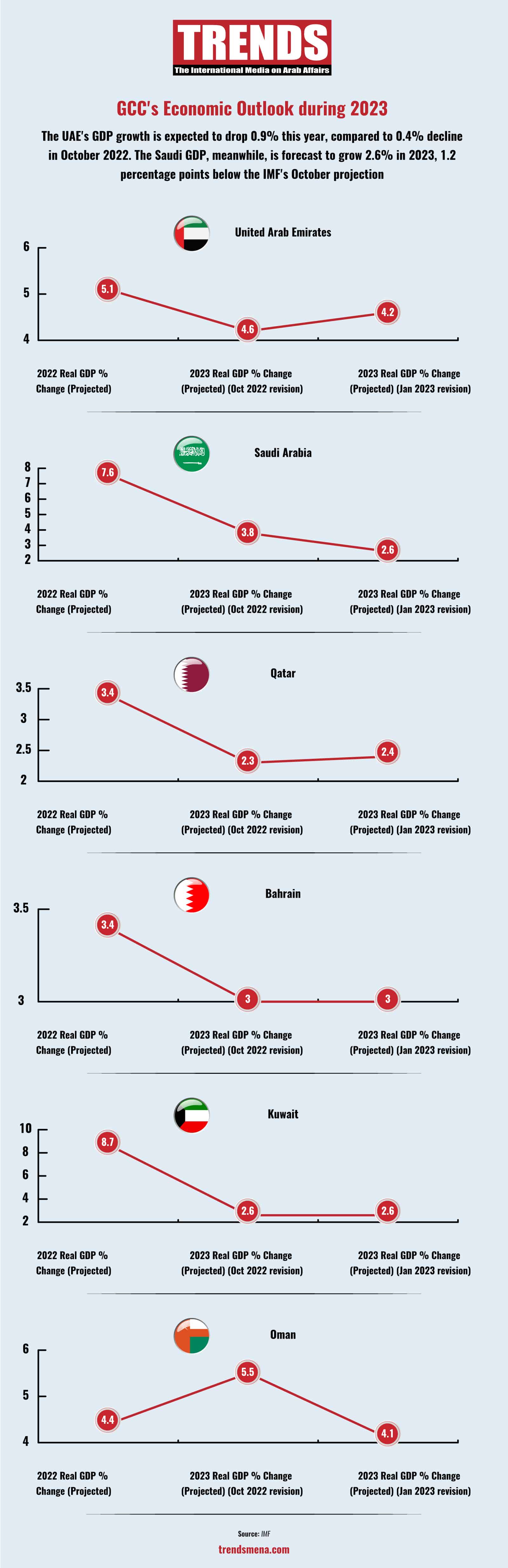

The region's biggest economy, Saudi Arabia, Growth was expected to accelerate to 8.3 percent in 2022 before moderating to 3.7 percent and 2.3 percent in 2023 and 2024, according to new World Bank Gulf Economic Update last year.