
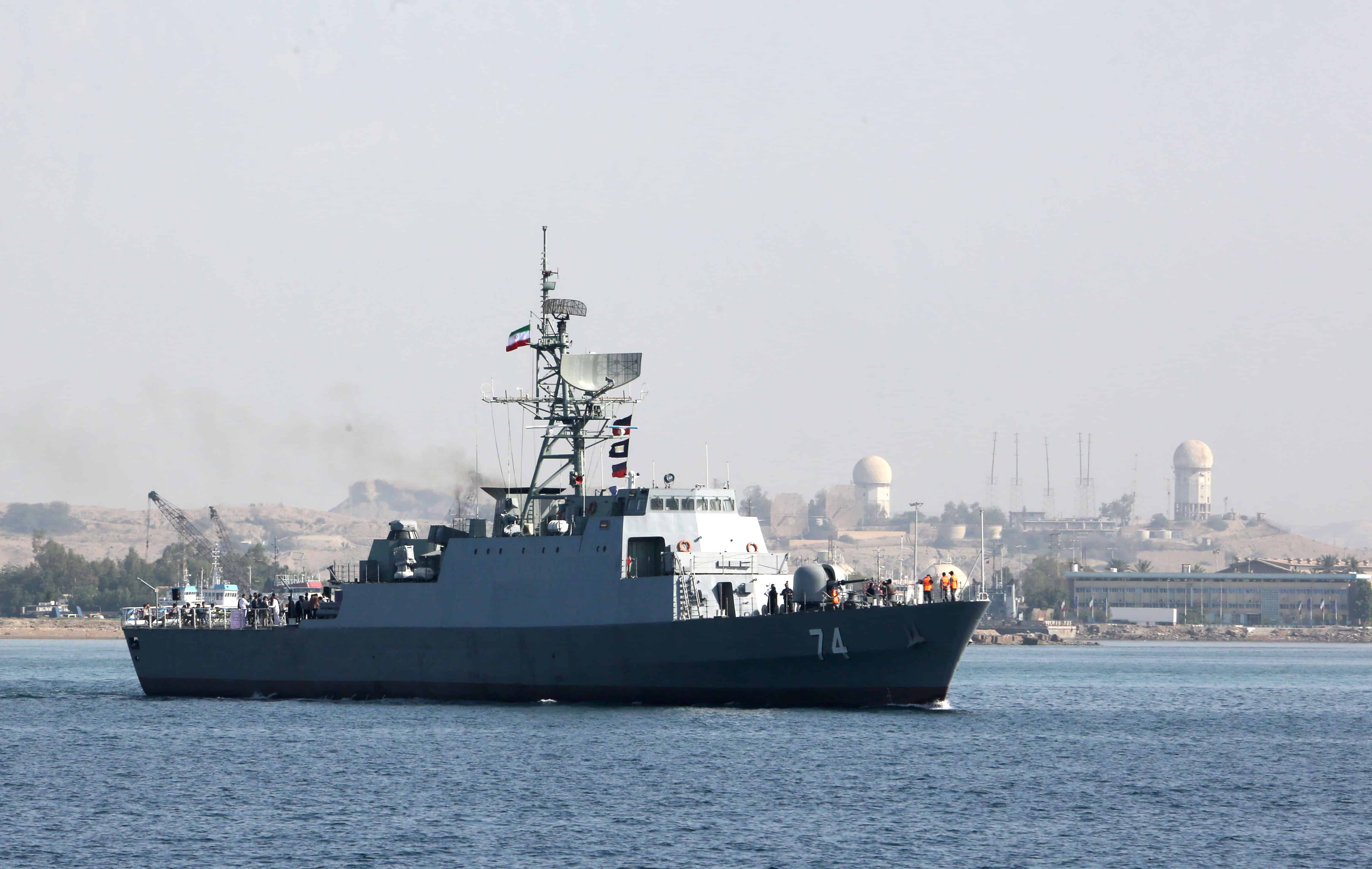

The United States military has carried out what it described as “limited defensive” strikes against Iranian targets in the Strait of Hormuz, raising fears of a renewed escalation even as Washington and Tehran continue indirect negotiations over ending the conflict.
A US official told the Associated Press that American forces struck Iranian targets after Iranian forces used surface-to-air missiles against US assets. The military action appeared limited rather than a full resumption of hostilities, according to the report.
The strikes followed reports of multiple explosions on Iran’s Qeshm Island, near the Strait of Hormuz, late on Monday. Iran’s official IRNA news agency said five explosions were heard in rapid succession, while witnesses reported seeing two aircraft flying over the island.
The semi-official Fars news agency also reported explosions in the port city of Bandar Lengeh, apparently coming from the sea.
Iran’s Islamic Revolutionary Guard Corps (IRGC) said it had shot down two US MQM-170 reconnaissance drones south of Qeshm Island and a US MQ-9 drone east of the Strait of Hormuz.
US media reports offered further details of the operation. The Wall Street Journal, citing US officials, reported that American forces had carried out air attacks on Qeshm Island as part of a series of limited strikes against Iranian targets in recent weeks.
The New York Times reported that the strikes were limited and that Washington had no immediate plans to escalate. Previous operations had targeted empty cruise missile launchers after the IRGC shot down an American drone and missed two US fighter jets flying over the Strait of Hormuz, according to the report.
Axios, citing a US official, said an American fighter jet destroyed an Iranian surface-to-air missile launcher after the IRGC fired at a US aircraft from Qeshm Island. NewsNation separately reported that radar detectors and missile launchers on the island had been targeted.
The developments came as US President Donald Trump renewed threats against Iran’s nuclear infrastructure, warning that Washington could strike the suspected underground nuclear complex known as Pickaxe Mountain if negotiations failed.
“We might have to go after Pickaxe. We can do that in one hour, as soon as we want, at any time we want,” Trump told Fox News.
He did not rule out a renewed war with Iran but said he preferred reaching an agreement. Trump said there was a “very good chance” of a deal, adding that an agreement would “save a lot of lives”.
Meanwhile, US Vice President JD Vance said Washington had made progress in indirect peace negotiations with Tehran. Iran, however, has insisted that the United States lift its naval blockade and address its demands before an agreement can be reached.
The military developments pushed oil prices higher in early trading on Tuesday. Brent crude futures rose 48 cents, or 0.5 percent, to $105.25 a barrel, while US West Texas Intermediate crude gained 47 cents, also 0.5 percent, to $96.93.
The gains followed a sharp decline on Monday, when Brent settled $8.66, or 7.63 percent, lower at $104.77 a barrel.
Diplomatic efforts also gathered pace, with China stepping up engagement with Iran and regional countries. Chinese Foreign Minister Wang Yi met Ali Bagheri Kani, deputy secretary of Iran’s Supreme National Security Council, in Beijing on Monday.
Wang said dialogue and negotiations remained “the only viable path forward”, warning that prolonged conflicts risked further regional spillover.
Chinese President Xi Jinping also hosted Oman’s Sultan Haitham bin Tariq for a landmark state visit, underscoring Beijing’s diplomatic engagement with a country that has played a role in regional mediation.