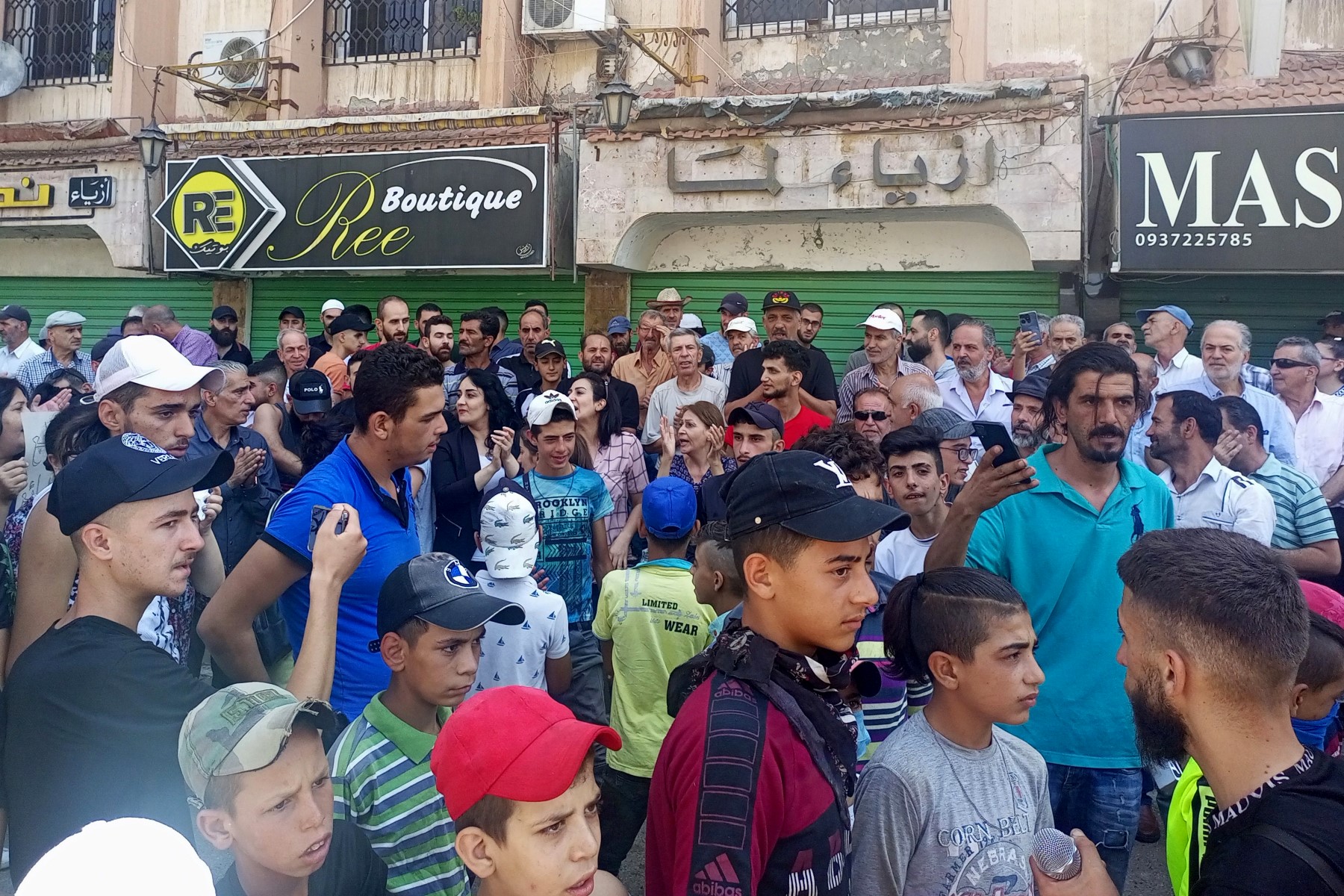

Beirut, Lebanon – Hundreds of demonstrators took to the streets again on Monday in Syria’s southern city of Sweida, local media and an activist reported, as dire living conditions stoke discontent in regime-held areas.
Days of rare protests have erupted in the south after the government lifted fuel subsidies last week, dealing a blow to Syrians already struggling with the heavy toll that 12 years of war have exacted on the economy.
Local news outlet Suwayda24 posted videos showing hundreds of people gathered in the city on Monday, holding banners and chanting anti-government slogans including “freedom” and “long live Syria, down with (President) Bashar al-Assad”.
“We’ve had enough, the Syrian people are suffocating,” one activist in Sweida said on condition of anonymity for security reasons, adding that hundreds had gathered to protest in the city.
Soaring inflation, the rising cost of living, instability and poverty have plagued the country, pushing desperate Syrians to take to the streets, the activist said.
Security forces have not cracked down on demonstrators so far, he noted.
“My only hope is that this movement will spread to other provinces and that our voices will be heard,” he told AFP.
Syria’s war has killed more than half a million people and displaced millions since it broke out in 2011 following Assad’s repression of peaceful pro-democracy protests.
It spiraled into a deadly conflict that pulled in foreign powers and global jihadists.
Sunday saw a strike over deteriorating living conditions and price hikes across Sweida province — the heartland of the country’s Druze minority — which has been mostly spared the worst of the civil conflict.
Protests
One senior Druze religious leader has expressed support for demonstrators and chastised the government.
Footage on Monday showed protesters carrying local Druze sheikhs on their shoulders.
In December, one protester and a policeman were killed when security forces cracked down on a demonstration in Sweida against deteriorating living conditions.
On Saturday, dozens demonstrated in southern Syria’s Daraa province, some raising the opposition flag and calling for Assad’s departure, according to the Syrian Observatory for Human Rights war monitor.
An activist said there were further protests on Sunday evening in the province, the cradle of Syria’s uprising.
Daraa returned to regime control in 2018 under a Russia-backed ceasefire deal, and has since been wracked by violence and dire living conditions.
Some residents also gathered in recent days in Jaramana, a suburb of the capital Damascus, to protest against recurrent power cuts, a witness told AFP.
The conflict has ravaged the country’s infrastructure and industry, the Syrian pound has lost most of its value against the dollar, and most of the population has been pushed into poverty.
Jihad Yazigi, editor of economic publication The Syria Report, said the fuel price hike came after years of punishing inflation, high unemployment and “generally an exhaustion of the population from the consequences of the war”, among other factors.
Resentment against Assad and his family “runs deep and the regime, which operates as a quasi-mafia, is simply incapable of offering long-term solutions”, he told AFP.
“The key will be to watch what happens in loyalist areas and in Damascus. That’s where it really matters,” he said.