


Democrats have seized control of both chambers of the US Congress in a sweeping midterm election victory that delivers a major setback to President Donald Trump, puts his administration under renewed congressional scrutiny and produces a historic breakthrough for Muslim political representation.
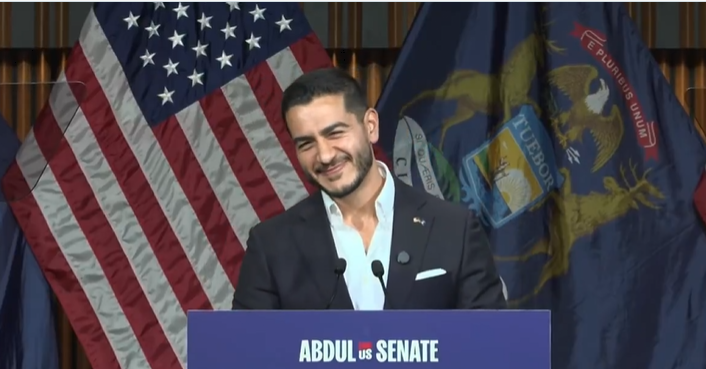
Abdul El-Sayed, a 42-year-old Democrat from Michigan, defeated Republican Mike Rogers to become the first Muslim elected to the US Senate, while Democrats secured majorities in the Senate and House of Representatives, ending Republican control of Congress.
The results represent a significant repudiation of Trump’s domestic and foreign policy agenda less than two years into his second presidency. The president acknowledged that the war against Iran contributed to his party’s losses, particularly through its impact on fuel prices, but insisted that the military campaign had been necessary and that he would make the same decision again.
Democrats secured 54 Senate seats against 44 for Republicans, according to the reported results, while two closely contested races in Alaska and Mississippi remained uncalled. In the House, Democrats won 237 seats, flipping 29 districts and reclaiming the chamber from Republicans.
The victories extended beyond traditional Democratic strongholds, with the party making significant gains in states where Trump had previously enjoyed considerable electoral support. Texas elected Democrat James Talarico to the Senate, while Gina Hinojosa won the gubernatorial race, becoming the state’s first woman governor and first Latina to hold the office.
Georgia also elected former Atlanta mayor Keisha Lance Bottoms as its first Black woman governor, while Democrats scored victories in Kansas, Maine, North Carolina and South Carolina.
The outcome sets up a dramatically different political environment for Trump during the remaining two years of his presidency, with Democrats preparing to use their congressional majorities to challenge administration policies, investigate government agencies and exercise greater control over federal spending.
Trump acknowledges Iran war’s electoral cost
Trump’s response to the defeat offered an unusually direct acknowledgement that his decision to launch military operations against Iran had damaged Republican electoral prospects.
In interviews with Fox News and The Wall Street Journal on Tuesday night and Wednesday, Trump conceded that the conflict had contributed to the outcome, although he continued to defend the military campaign.
“I think a part of it was Iran,” Trump told Fox News, while separately telling The Wall Street Journal that “Iran was a piece of it”.
Asked about Vice President JD Vance’s assessment that the war had caused the Republican defeat, Trump said the argument was largely correct because the conflict had pushed gasoline prices higher.
“Well, I think it’s largely true because it drove the gasoline up a little bit short-term,” he said.
However, the president rejected the suggestion that the electoral consequences should prompt a reassessment of the military campaign.
“I did the right thing,” Trump told The Wall Street Journal. “I would have done it again.”
Speaking at the White House on Wednesday, he maintained that the United States had no choice but to act to prevent Iran from acquiring nuclear weapons.
“The Iran thing we had to do, and we continue to do it,” he said, arguing that the long-term security implications outweighed the immediate economic and political costs.
Trump also suggested that voters were reacting more strongly to the economic consequences of the conflict than to the military operation itself. He said he had expected oil prices to rise considerably more following the campaign.
The president additionally sought to distance himself from the Republican candidates’ performances, arguing that his personal popularity had not translated into votes for the party.
He said that had he himself been on the ballot, Republicans would have won, adding that the enthusiasm at his campaign rallies had not transferred to candidates.
“There was such love at those rallies, it was incredible and we weren’t able to transfer the love to candidates,” he said.
Trump also indicated that he would work with Democrats on some issues but warned that he retained presidential veto powers and would use them against legislation he opposed.
Vance delivers blunt assessment of Republican defeat
Vance offered a considerably more critical assessment of the election outcome, directly identifying the Iran war as the principal reason Republicans had lost control of Congress.
“The reason we lost is the war,” Vance wrote on X on Wednesday, in a lengthy post that also highlighted the cost-of-living crisis, inflation and voter dissatisfaction with US policy towards Israel.
The vice president said Republican strategists had underestimated the extent to which voters who supported Trump and Vance in 2024 had become disillusioned with the administration.
He identified four issues that had driven voters away: ending the war in Iran, addressing living costs and inflation, putting American interests first and changing the country’s relationship with Israel.
Vance also challenged those defending the conflict to explain whether its political consequences, including losing the Senate for the next six years, had been worth the price.
His intervention exposed tensions within the administration over the political consequences of the war and its broader foreign policy direction.
Democratic leaders seized on the admission, with Illinois Governor JB Pritzker accusing Vance of trying to evade responsibility for policies he had supported.
Former Secretary of State Antony Blinken said the results sent a clear message in favour of a diplomatic resolution to Trump’s war with Iran.
Democratic Senator Chris Van Hollen also called for an end to military funding for the conflict beyond the December 11 funding deadline.
El-Sayed makes history amid divisive campaign
El-Sayed’s victory in Michigan emerged as one of the most consequential individual results of the election.
The former public health official defeated Rogers in a closely watched contest for the seat being vacated by retiring Democratic Senator Gary Peters.
The son of Egyptian immigrants, El-Sayed built his campaign around universal healthcare, reducing the cost of living and limiting the influence of corporate money in American politics.
His platform included Medicare for All, a government-funded healthcare programme long championed by the Democratic Party’s progressive wing.
His campaign also became a flashpoint in the debate over American policy towards Israel. El-Sayed opposed US military assistance to Israel and described its actions in Gaza as genocide, positions that attracted criticism from political opponents and sections of the Democratic establishment.
Trump repeatedly attacked the candidate, describing him as a “jihadist”, while Republican allies questioned his political loyalties and sought to associate him with Islamic extremism.
Michigan Republican Party chair Jim Runestad subsequently suggested that Trump’s rhetoric had helped El-Sayed by making members of the wider Muslim community feel targeted.
“You have to be very careful about a whole community feeling that they are being attacked with your words,” Runestad said.
El-Sayed also faced opposition from within his own party. Representative Haley Stevens, whom he defeated in the Democratic primary, endorsed Rogers shortly before Election Day, arguing that El-Sayed’s positions on Israel had become increasingly problematic.
The intervention intensified divisions among Democrats but did not prevent El-Sayed from securing the seat.
New York Mayor Zohran Mamdani welcomed the victory, saying it carried enormous significance for supporters who had backed El-Sayed despite the financial and political opposition he faced.
Democrats prepare to challenge Trump agenda
The Democratic victory is likely to reshape congressional politics across several major policy areas, including immigration, military spending, healthcare and oversight of the administration.
Representative Bennie Thompson, the ranking Democrat on the House Homeland Security Committee, has already demanded that the Department of Homeland Security preserve records, emails and contracts amid allegations of excessive force and impropriety during immigration enforcement operations.
Republican and Democratic lawmakers have also called for Defence Secretary Pete Hegseth to face scrutiny following the election. Republican Senator Thom Tillis warned that Hegseth would face a reckoning, while Democratic lawmakers renewed demands for his removal.
The change in congressional control could also have consequences for the Supreme Court. Democrats will be able to block Trump’s judicial nominees when the new Congress takes office in January, potentially limiting his ability to reshape the court if vacancies arise.
Democratic leaders have meanwhile promised to prioritise affordability, healthcare, electricity and fuel prices.
House Democratic leader Hakeem Jeffries described the result as an “American tsunami”, arguing that voters had rejected corruption, chaos and cruelty.
Senate Democratic leader Chuck Schumer said the party would focus on making everyday life more affordable, including addressing gasoline and diesel prices by ending the war.
For Trump, the election represents a substantial political setback and the loss of unified Republican control of Congress. For Democrats, it offers an opportunity to challenge his administration while testing whether the coalition that delivered the midterm victories can sustain its momentum into the 2028 presidential election.
Research verification: Trump’s fuller remarks add three important details: he said Iran had contributed to the defeat by pushing up gasoline prices; he insisted the military campaign was worth the political cost; and he argued Republicans would have won had he personally been on the ballot. He also threatened to veto legislation he opposed.