
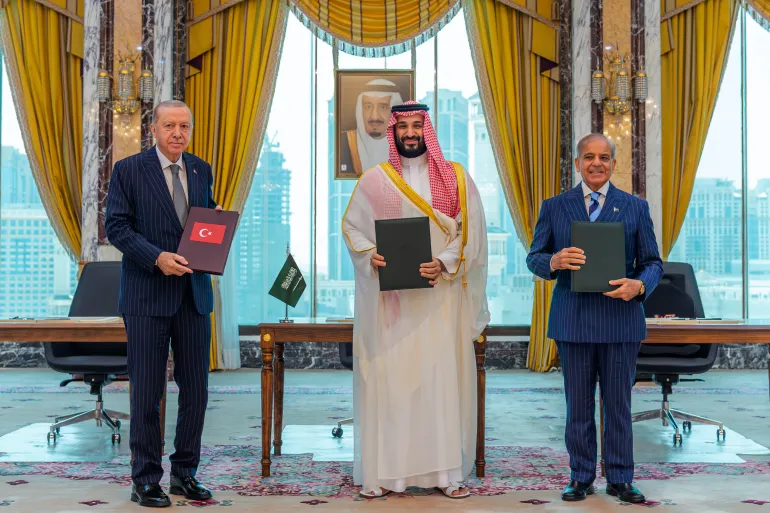

Turkiye’s parliament has ratified a trilateral defence agreement with Saudi Arabia and Pakistan, paving the way for deeper military cooperation as Riyadh faces renewed attacks by Yemen’s Iran-backed Houthis.
The agreement, signed by the three countries in Mecca on August 7, includes a collective defence provision requiring members to assist one another in the event of an armed attack.
The ratification on Thursday followed parliamentary debate over the agreement’s provisions, with 279 lawmakers voting in favour and 119 against. A total of 398 of the parliament’s 592 members participated in the vote.
Turkiye, which has NATO’s second-largest military, had signed the Mecca Joint Defence Agreement in August and submitted it to parliament for ratification last month.
Collective defence provisions
The 16-article agreement commits the signatories to using all necessary means to eliminate threats to one another’s territorial integrity.
Article 1 establishes the collective defence principle, while Article 2 specifies that if a member is subjected to an armed attack or military aggression by another country or group of countries, the other parties must immediately provide assistance using available mutual support measures.
The provision closely resembles Article 5 of the North Atlantic Treaty, under which an armed attack against one NATO member is considered an attack against all.
Turkiye’s membership of both NATO and the Mecca pact has raised questions about potential conflicts of interest when Ankara allocates its military resources. Turkish officials have dismissed those concerns.
Beyond collective defence, the agreement provides for closer cooperation in defence industries, joint military training, technological innovation, intelligence sharing and logistical coordination.
The pact has an initial 10-year duration, after which members can withdraw. It also allows additional countries to join with the approval of existing signatories.
Syria has expressed interest in joining the arrangement, with its foreign minister saying Damascus was considering participation.
Ankara signals focus on deterrence
Parliamentary ratification does not automatically mean Turkish troops will be deployed to Saudi Arabia as attacks by the Houthis continue.
Any troop deployment would require further legislative procedures, while the precise nature of Ankara’s military assistance remains to be determined.
Turkish Defence Minister Yasar Guler said in October that the scope of potential support for Saudi Arabia would be established after parliamentary ratification.
Turkiye did not envisage becoming directly involved in a conflict with the Houthis, Guler said, according to Turkish media. Its contribution would instead focus on strengthening deterrence.
The agreement nevertheless provides a framework for closer military coordination between the three countries at a time of heightened regional insecurity.
Houthi attacks heighten Saudi security concerns
Tensions between Saudi Arabia and Yemen had eased following a 2022 ceasefire, but Houthi attacks against the kingdom have intensified in recent months.
The group has launched a series of deadly strikes targeting King Khalid International Airport in Riyadh, adding to concerns over the security of Saudi infrastructure.
Saudi Arabia also announced on Thursday that it had intercepted a drone in the Medina region.
Riyadh has repeatedly accused the Houthis of targeting Mecca and Medina, Islam’s two holiest cities. The Iran-backed group has consistently rejected those accusations.
The security situation is further complicated by the US-Israel war on Iran, which has heightened cross-border tensions and increased uncertainty across the Middle East.
Against this backdrop, the Mecca agreement provides Saudi Arabia, Pakistan and Turkiye with a formal framework for coordinated responses to potential security threats.