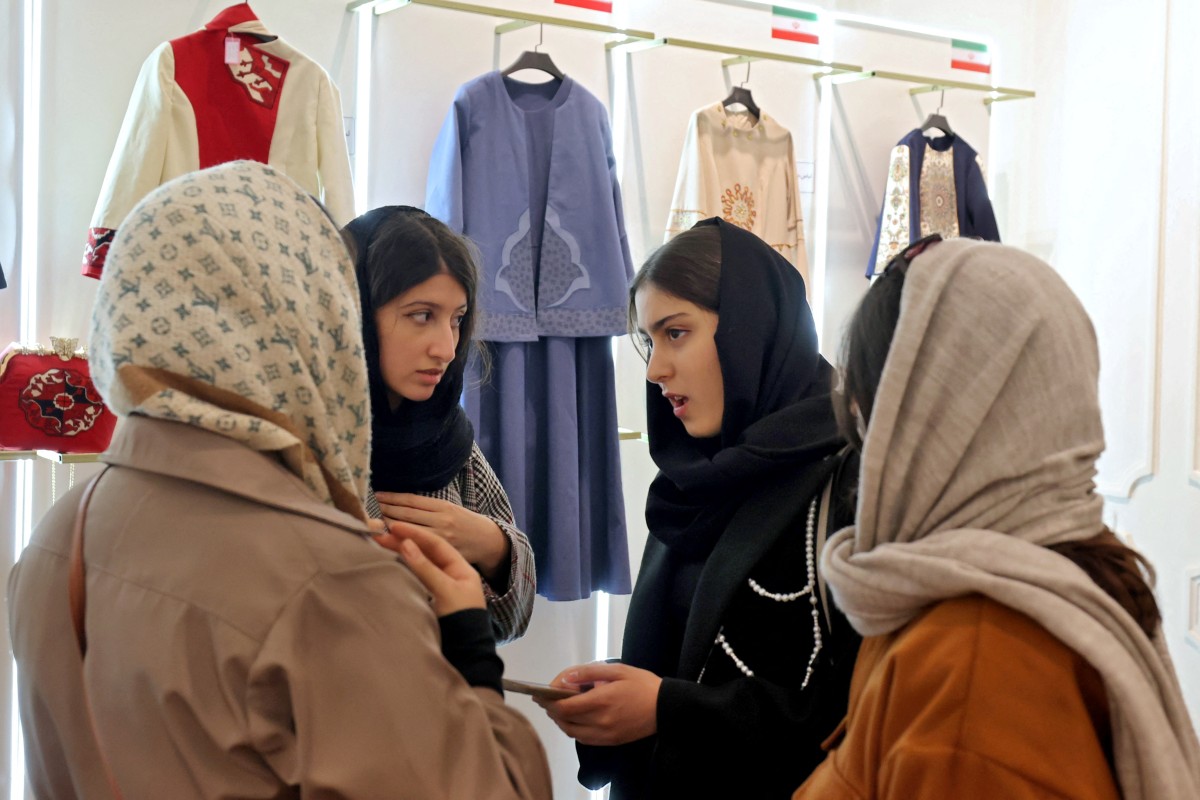

Tehran, Iran – Moving away from dark clothing, Iranian designers are trying to strike a fine balance between a growing trend favoring bright colors and the Islamic republic’s strict dress code for women.
“As a young woman, I choose clothes in a modern design with bright colours,” 22-year-old designer Hadis Hassanlou told AFP at a fashion exhibition in the historic Saadabad Palace in Tehran.
Since shortly after the 1979 revolution, women in Iran have had to observe a strict dress code and wear loose-fitting garments while also covering the head and neck.
When they venture out into the streets, many women opt for head-to-toe black chadors. But in recent years, Iranian designers have also sought to include brighter colors in their creations.
New designs at the exhibition, where some 50 garments were on show, included everything from black chadors to long floral-patterned dresses and coats fitted at the waist.
“When designing, I first take society’s norms and rules into consideration,” said designer Sanaz Sarparasti.
She says her colourful designs aimed to keep up with growing trends among young Iranian women.
They “want to be freer, more modern and more up-to-date in how and what they wear”, Sarparasti said.
The strict dress code for women has been the subject of heated debate since nationwide protests following the death in custody in September 2022 of Mahsa Amini.
Amini, a 22-year-old Iranian Kurd, had been arrested for allegedly breaching the dress code.
During the protests, many women demonstrators cast off their headscarves or even burned them. Others increasingly began to flout the clothing rules, leading to a severe crackdown by the authorities.
Strict norms
Designers say the shift to brighter colours has not been easy, especially as many women still stick to darker shades.
“Societal norms and the country’s regulations often require darker colours,” said Afshin Parsaee.
“We still need to produce them as well,” the designer said.
Besides wearing a hijab covering the head and neck, women who work in government offices are required to wear dark, long Islamic uniforms.
At the exhibition, Culture Minister Mohammad Esmaili said clothing was “the most important cultural symbol of any civilisation”, and hailed what he called the “modest” characteristic of Islamic clothing in Iran.
Hassanlou said she has sought to combine colours with Iran’s traditional art of calligraphy in her designs which she says are derived from “original Persian fashion” that has evolved over thousands of years.
“One of my goals when designing an outfit is that it be modern and colourful, even while following calligraphic tradition,” she said.
Others hope to see their work one day in prominent fashion capitals.
“We’ve put on the agenda promoting Persian clothing fashion week in Paris, Milan and London,” said Hadis Pazouki, head of the country’s national fashion, clothing and lifestyle foundation.
“We believe that exquisite Persian clothes can be worn by anyone, not only Iranians.”
For fashion exhibition visitor Fatemeh Fazeli, 19, the shift to brighter colours has been a welcome change.
“I can never wear a dark-coloured headscarf … except at funerals,” she said.
“When you wear bright colours your mood changes and you feel better.”