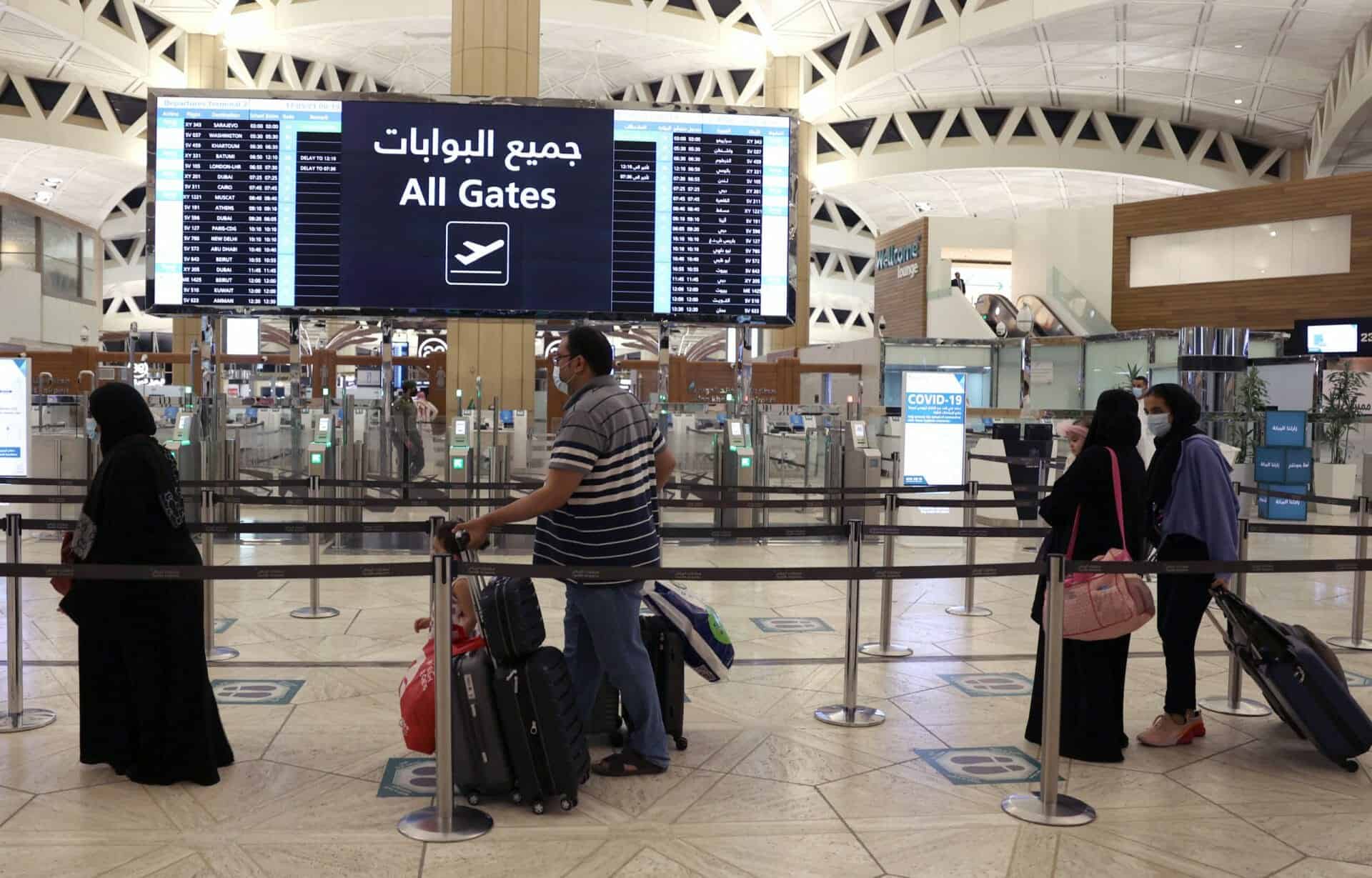

Saudi Arabia’s capital Riyadh has emerged as a key exit route for wealthy residents fleeing the United Arab Emirates after Iranian retaliatory strikes hit the region, the Daily Mail reported.
According to the report, billionaires and senior executives have been leaving Dubai and Abu Dhabi after Iranian drones and missiles targeted multiple locations following US-Israeli strikes on Iran. At least three civilians were reported killed in Dubai.
With airspace across parts of the Middle East locked down and thousands of flights cancelled or delayed, King Khalid International Airport remains one of the few major hubs still operating. As a result, private jets and commercial flights from Riyadh are being used to evacuate high-net-worth individuals and corporate executives.
The Daily Mail said fleets of SUVs have been transporting wealthy families along desert highways from Dubai to Riyadh, with private jet charter prices reportedly soaring. A private flight from Riyadh to Europe is said to cost up to $350,000 amid surging demand.
While missile threats were reportedly intercepted near Riyadh, Saudi airspace has remained open. The report noted that recent visa relaxations have also made it easier for foreign nationals to enter the kingdom, positioning Riyadh as a temporary safe passage for those seeking to leave the conflict-hit region.
Amazon Web Services Data Center in UAE Hit by ‘Objects,’ Fire Disrupts Connectivity
An Amazon Web Services (AWS) data center in the United Arab Emirates was hit by “objects” on Sunday, sparking a fire and causing a power outage that disrupted connectivity, the company said.
AWS said one of its “Availability Zones” was “impacted by objects” at around 7:30 a.m. ET. The impact created “sparks and fire,” per AWS.
“The fire department shut off power to the facility and generators as they worked to put out the fire,” the company said.
The company did not specify what the objects were. According to AWS, an availability zone can consist of one or more data centers. The company operates three availability zones in the UAE.
The incident occurred amid heightened tensions in the region following US and Israeli military strikes on Iran and retaliatory attacks by the Iranian military on several Gulf states. Over the weekend, photos and videos showed missiles streaking across the sky in Dubai, with debris from intercepted missiles causing fires and other disruptions.
Just before 7:30 p.m. ET, AWS said it was seeing “significant signs of recovery” for some systems, though power remained down at the affected facility.
“We do not have an ETA for power restoration at this time. For customers that can, we recommend using alternate Availability Zones or other AWS Regions where applicable,” the company said in its Sunday evening statement.
Israel and Hezbollah Exchange Heavy Strikes After Missiles Fired from Lebanon
Israel launched intense airstrikes on Beirut’s southern suburbs early Monday after Hezbollah fired missiles and drones towards Israel, saying the attack was in revenge for the killing of Iran’s Supreme Leader Ali Khamenei, Reuters reported
Multiple explosions shook the Hezbollah-controlled Dahiyeh district around 2:40 a.m., sending residents fleeing on foot and by car as roads quickly became congested. Lebanese security sources said the strikes hit several locations in the southern suburbs, marking the most intensive bombardment there since the 2024 war between Israel and Hezbollah.
The escalation follows U.S. and Israeli attacks on Iran over the weekend, widening a conflict that has rippled across the Middle East. Hezbollah, founded in 1982 with backing from Iran’s Revolutionary Guards, is one of Tehran’s key regional allies.
The Israeli military said it had begun targeting Hezbollah positions across Lebanon, including senior members of the group in the Beirut area.
“Hezbollah opened a campaign against Israel overnight, and is fully responsible for any escalation,” Israeli Chief of the General Staff Eyal Zamir said in a statement, cited by Reuters.
Israel also ordered residents of dozens of villages in southern and eastern Lebanon to evacuate. There was no immediate word from Lebanon’s health ministry on casualties.
The Israeli military said several projectiles launched from Lebanon fell in open areas, while one was intercepted by the air force.
Hezbollah said it had targeted an Israeli military missile defence facility south of Haifa in response to what it described as repeated Israeli attacks and to avenge “the pure blood” of Khamenei.
“The resistance leadership has always emphasised that the continuation of Israeli attacks and the assassination of our leaders, youth, and people gives us the right to defend ourselves and respond at the appropriate time and place,” Hezbollah said in a statement.
It was the first such attack by Hezbollah since the 2024 war, during which the group was significantly weakened and its leader Hassan Nasrallah was killed.
Since a U.S.-brokered ceasefire between Israel and Lebanon in 2024, Israel has continued to carry out strikes against what it says are Hezbollah targets, accusing the group of attempting to rearm. Monday’s strikes were also the first on Beirut’s southern suburbs since Israel killed the group’s top military official Ali Tabtabai in November.
Israel also conducted airstrikes in southern Lebanon and the Bekaa Valley, according to Lebanese security sources.
Lebanese Prime Minister Nawaf Salam criticised the firing of projectiles from southern Lebanon, calling it irresponsible and describing it as a suspicious act that endangered the country’s security.
Lebanon’s presidency said on Saturday it had been informed by the U.S. ambassador that Israel would not escalate against Lebanon as long as there were no hostile acts from the Lebanese side.
Iran war: 3 killed, 58 injured in strikes on UAE, Saudi Arabia summons Iran ambassador
The UAE has detected 165 ballistic missiles, destroying 152, and intercepted two cruise missiles, its defence ministry said. A total of “541 Iranian drones were detected, 506 of which were intercepted and destroyed”, the ministry added in a statement.
The attacks resulted in the deaths of three people of Pakistani, Nepalese and Bangladeshi nationality, it said.
Saudi Arabia summons Iran ambassador over Gulf attacks
Saudi Arabia’s foreign ministry said it summoned the Iranian ambassador, a day after the kingdom accused Tehran of targeting its territory with strikes.
“Foreign Ministry summons the Iranian ambassador to the Kingdom in response to Iran’s brazen attacks that targeted the Kingdom and a number of brotherly countries,” the ministry said in a statement on its X account.
Israeli death toll 8.
Israeli ambulance services say eight people have been killed in a strike in central Israel. The country’s Magen David Adom rescue service had earlier put the death toll from the strike at six, and a spokesperson said searches are ongoing for additional victims. Iran has launched dozens of rockets at Israel since the United States and Israel launched a surprise attack on Iran on Saturday.
Gulf countries to hold video meeting on Iran attacks on Sunday evening
Gulf countries will convene Sunday evening to discuss a unified response to Iran’s attacks, two Gulf diplomats said, as Tehran presses on with a second day of strikes after US and Israeli attacks killed its supreme leader, according to AFP.
Arafi appointed jurist member
Alireza Arafi has been appointed as the jurist member of Iran’s Leadership Council, a body tasked with fulfilling the supreme leader’s role until the Assembly of Experts elects a new leader, ISNA news agency reports.
A cleric member of the Guardian Council, Arafi will be part of the temporary Leadership Council alongside President Masoud Pezeshkian and Chief Justice Gholamhossein Mohseni Ejei, according to France24.
Here are other major developments:
Putin expresses condolences over Khamenei’s death
Russian President Vladimir Putin has extended his condolences over Ayatollah Khamenei’s death to his Iranian counterpart Masoud Pezeshkian, calling it a “cynical violation” of morality and international law.
“Please accept my deep condolences in connection with the murder of the Supreme Leader of the Islamic Republic of Iran, Seyed Ali Khamenei, and members of his family, committed in cynical violation of all norms of human morality and international law,” Putin said in a note to Iranian counterpart.
“We will leave no stone unturned to make sure that we defend ourselves,” UAE’s Minister of State for International Cooperation Reem Al Hashimy told CNN in an interview.
One person was killed in a drone attack early morning on Zayed International Airport.
UAE official news agency WAM reported: “Abu Dhabi Airports has announced that the competent authorities in the Emirate of Abu Dhabi dealt with an incident resulting from the interception of a drone that had targeted Zayed International Airport, leading to falling debris that caused one fatality of an Asian national and seven injuries.”
“Abu Dhabi Airports urged the public not to circulate rumours or inaccurate information, stressing the need to obtain news from official sources only, and affirming that any developments will be announced as soon as they are received.”
Khamenei killing is a declaration of war against Muslims: President
The killing of supreme leader Ayatollah Ali Khamenei in US and Israeli strikes is a “declaration of war against Muslims”, Iran’s President Masoud Pezeshkian said in a statement.
“The assassination of the highest political authority of the Islamic Republic of Iran and a prominent leader of Shiism worldwide… is perceived as an open declaration of war against Muslims, and particularly against Shiites, everywhere in the world,” he said.
“The Islamic Republic of Iran considers it its legitimate duty and right to avenge the perpetrators and masterminds of this historic crime,” he added.
Chief of army staff, defense minister killed
Iran’s chief of army staff Abdolrahim Mousavi has been killed in airstrike targeting a meeting of the country’s defence council, state TV reported on Sunday. Iran’s Defence Minister Aziz Nasirzadeh is also reported to have died in the attack, France24 reported.
Fars news agency reported that Iran’s police intelligence chief Gholamreza Rezaian has been killed “following yesterday’s (Saturday) enemy attacks”.
Supreme Leader killed in airstrikes
Iran’s state media on Sunday confirmed the death of Supreme Leader Ayatollah Ali Khamenei following U.S.-Israeli attacks, marking a dramatic escalation in the conflict and plunging the country into uncertainty over its leadership.
Iranian President Masoud Pezeshkian and two other top officials will lead Iran in the transitional period following the death of supreme leader Ali Khamenei, state television reported on Sunday.
Judiciary chief Gholamhossein Mohseni Ejei and another official from the country’s legal council will be part of the trio overseeing the transition, according to state television which cited Mohammad Mokhber, one of Khamenei’s advisors.
U.S. President Donald Trump had announced Khamenei’s death hours earlier and urged Iranians to take control of their government. Iranian officials initially dismissed the reports as psychological warfare, but confirmation came Sunday morning from Tehran as a second day of fighting unfolded.
According to Tasnim, Iran’s semi-official state news agency, Khamenei died early Saturday in an attack on his office at his residence. It was not immediately clear whether American or Israeli strikes were responsible for killing the leader, who had ruled Iran for decades and was a staunch adversary of both Washington and Tel Aviv.
The announcement came amid a fresh wave of attacks across Iran, intensifying fears of a broader regional conflict.
The powerful Islamic Revolutionary Guard Corps, which answers directly to the supreme leader, vowed to retaliate against what it described as U.S. and Israeli aggression. However, there was no immediate clarity on who would assume leadership in Iran following Khamenei’s death.
The developments have heightened tensions across the Middle East, with the situation evolving rapidly.
Mourning Iranians gather in Tehran square
Thousands of mourners gathered on Sunday in the centre of Iran’s capital after the death of Iran’s supreme leader Ayatollah Ali Khamenei, according to AFP.
The mourners, dressed mostly in black and some crying, chanted “death to America” and “death to Israel” in Enghelab (Revolution) Square, with many waving Iran’s flags and holding photos of Khamenei.
Sirens across central Israel as army seek to intercept Iran missiles
Israel’s military said it was responding to Iranian missile fire on Sunday, with air raid sirens activated across central Israel and parts of the occupied West Bank.
Explosions, smoke near Iraq airport hosting US-led troops
Loud explosions were heard early Sunday near Erbil airport, which hosts US-led coalition troops in Iraq’s autonomous Kurdistan region, a France24 report said, citing an AFP journalist who reported seeing thick black smoke rising from the airport area.
On Saturday, US-led coalition forces downed several missiles and explosive-laden drones over Erbil.
Oil Majors Halt Shipments as Iran Closes Strait of Hormuz
Several global oil majors, tanker owners and commodity trading houses have suspended shipments through the Strait of Hormuz after Iran announced it was closing navigation in the vital waterway following U.S. and Israeli strikes.
Trading sources said on Saturday that crude oil, refined fuels and liquefied natural gas (LNG) cargoes were being held back amid mounting security concerns in the Gulf, reports said.
Satellite images from tanker-tracking services showed vessels clustered near major regional ports, including Fujairah in the United Arab Emirates, rather than transiting through Hormuz.
An official with the European Union’s naval mission Operation Aspides told Reuters that multiple vessels in the area had received VHF transmission from Iran’s Revolutionary Guards stating that “no ship is allowed to pass the Strait of Hormuz”.
However, the UK Navy said Iran’s orders were not legally binding and advised vessels to transit with caution.
The tanker owners’ association INTERTANKO said the U.S. Navy had also warned against navigation across a broad maritime zone — covering the Gulf, the Gulf of Oman, the North Arabian Sea and the Strait of Hormuz — and indicated it could not guarantee the safety of shipping.
In a separate announcement on February 28, the Iranian Navy said it had formally shut the Strait to all vessel traffic, reports said.
The narrow waterway, which links the Persian Gulf and the Gulf of Oman to the Arabian Sea, is regarded as one of the world’s most strategically important energy corridors. Iran borders one side of the Strait, while Oman lies on the other.
Energy analysts warn that a prolonged shutdown could send global oil prices sharply higher. Experts caution that a full closure could push prices to $250 per barrel, up from the current $80 range.
Roughly 15–20% of global oil, condensates and petroleum product supplies — along with more than 30% of the world’s LNG — transit the Strait. Around 82% of the crude volumes shipped through the passage are destined for Asian markets, with the remainder largely heading to Europe. Nearly a quarter of China’s LNG imports pass through the route.
The Strait typically handles between 200 and 300 vessels daily, making it one of the busiest maritime corridors in the world.
Dubai’s Palm Jumeirah Hit in Attack; Four Injured, Reports Say
Authorities in Dubai said an incident at a building in the Palm Jumeirah district left four people injured. Emergency response teams were deployed to the scene and secured the area, while Dubai Civil Defence extinguished the fire that broke out, according to the Dubai Media Office.
Those injured were transported to hospitals for treatment. Officials said all necessary steps are being taken to safeguard public safety.
“Dubai authorities confirm that an incident occurred in a building in the Palm Jumeirah area. Emergency response teams were deployed immediately and the site has been secured. Dubai Civil Defence has confirmed that the resulting fire is now under control. Four individuals sustained injuries and have been transferred to medical facilities,” Dubai Media Office said in a statement. “The safety and wellbeing of residents and visitors remain the highest priority. Authorities continue to take all necessary measures to safeguard the public. The public is urged to remain calm, rely solely on verified information from official sources, and refrain from circulating videos or images on social media. Further updates will be provided as they become available.”
The United Arab Emirates on Saturday announced a temporary partial closure of its airspace and issued an emergency alert in Abu Dhabi as regional tensions escalated following joint U.S.-Israeli strikes on Iran and retaliatory missile launches by Tehran.
The UAE’s General Civil Aviation Authority said the move was taken as an “exceptional precautionary measure” in coordination with national security authorities and international partners. The step followed a comprehensive risk assessment aimed at ensuring the safety of civilian aircraft, aircrews and national airspace.
Airports including Zayed International Airport in Abu Dhabi and Dubai International Airport remained operational for ground services, but flight schedules were disrupted, with delays, cancellations and diversions reported.
Etihad Airways, which operates from Zayed International, said its services were affected, with some flights delayed or rerouted. Wizz Air suspended flights to and from Dubai, Abu Dhabi, Israel and Amman until March 7. Flydubai also reported disruptions due to airspace closures over Iraq, Iran and Israel. British Airways canceled flights to Tel Aviv and Bahrain through March 3.
Similar restrictions were announced across the region. Qatar, Kuwait, Bahrain and Iraq suspended civilian air traffic, while Israel closed its airspace to non-military flights. Iran’s Civil Aviation Organization halted operations for at least six hours.
In Abu Dhabi, residents received an emergency text message from the Ministry of Interior shortly before 2 p.m., urging them to remain alert and follow official instructions. The alert came amid reports of explosions and air defense activity in the capital.
Residents said they heard loud blasts and saw smoke near Al Dhafra Air Base, which is used by UAE and U.S. forces. State media reported that UAE air defense systems intercepted multiple Iranian ballistic missiles.
According to the state news agency WAM and Reuters, one person was killed when debris from an intercepted projectile fell in a residential area. Several others were treated for minor injuries. The Ministry of Defence described the incident as a “blatant attack” and said the UAE reserved the right to respond, stressing that its sovereignty had been violated.
The U.S. Embassy in Abu Dhabi and the Consulate in Dubai advised staff to shelter in place and urged American citizens to do the same. The advisory recommended staying in secure locations, keeping essential supplies and monitoring official updates. U.S. nationals were also encouraged to enroll in the Smart Traveler Enrollment Program for assistance and updates.
Iran’s Supreme Leader to address nation amid escalating conflict
Iran’s Supreme Leader, Ali Khamenei, is expected to address the nation shortly, according to Iran’s Al-Alam TV, as tensions escalate following U.S. and Israeli military strikes on Iranian targets.
The anticipated address comes amid intensifying hostilities across the region. U.S. President Donald Trump confirmed that the United States has launched “major combat operations” in Iran after Israeli missile attacks. In response, Iran has reportedly targeted U.S. and Israeli assets in several Middle Eastern countries, including Qatar, the UAE, Kuwait, Bahrain, Syria, Jordan, Saudi Arabia and Iraq.
U.S. officials indicated that the current campaign marks the first day of what could be an extended military operation lasting a week or longer. They warned that further missile interceptions and debris fallout may occur in the coming days as the conflict unfolds.
Explosions heard across Middle East as Iran retaliates after US-Israel strikes; flights disrupted
Explosions were reported across parts of the Middle East on Saturday after the United States and Israel launched a “broad & joint operation” in Iran, according to the Israel Defense Forces. Iran responded with missile strikes targeting Israeli territory and U.S. military bases in the Gulf region.
Several Gulf countries confirmed intercepting Iranian missiles. Bahrain, Kuwait, Qatar, Jordan and the United Arab Emirates — all of which host U.S. bases — said their air defense systems were activated.
In the UAE, authorities said, “the Ministry of Defense announced that the country was subjected today to a blatant attack by Iranian ballistic missiles, which was dealt with by the UAE air defenses with high efficiency and a number of missiles were successfully intercepted.”
Reports from Abu Dhabi and Dubai indicated multiple loud explosions were heard in both cities.
Qatar also condemned the attack. In a statement, its Ministry of Defense said the “State of Qatar expresses its strong condemnation of the targeting of Qatari territory with Iranian ballistic missiles, considering it a flagrant violation of its national sovereignty, a direct infringement on its security and territorial integrity, and an unacceptable escalation that threatens the security and stability of the region.”
Bahrain confirmed that “the services center affiliated with the Fifth Fleet was subjected to a missile attack.”
Saudi Arabia, which was not directly targeted, issued a statement condemning Iran’s actions and denouncing what it described as a “flagrant violation of the sovereignty of the UAE, Bahrain, Qatar, Kuwait, and Jordan.” The Kingdom also expressed its “readiness to place all its capabilities at their disposal in support of any measures they may undertake.”
Israel, which participated in the joint operation alongside the United States, said via its Israeli Defense Forces account on X that an “additional barrage of missiles was launched toward Israel. The Aerial Defense Array is currently identifying and intercepting threats.” Air raid sirens continued to sound across parts of the country throughout Saturday, officials said.
U.S. embassies across the region advised staff and American citizens to shelter in place until further notice.
U.S. President Donald Trump said on Truth Social that “the United States military began major combat operations in Iran. Our objective is to defend the American people by eliminating imminent threats from the Iranian regime, a vicious group of very hard, terrible people.”
Global Airlines Suspend Flights as Middle East Airspace Empties After Strikes on Iran
Airlines across the world have suspended or rerouted flights through parts of the Middle East after military strikes by the United States and Israel on Iran triggered heightened security concerns across the region.
Airspace over Iran, Iraq, Kuwait, Israel and Bahrain appeared largely empty on flight-tracking data from Flightradar24, as carriers moved quickly to avoid potential risk zones.
The European Union Aviation Safety Agency (EASA) advised airlines to avoid operating in the affected airspace until further notice, citing passenger and crew safety concerns. The precautionary guidance followed the escalation in tensions after coordinated strikes targeted sites inside Iran.
Several major international airlines announced temporary suspensions of services to key Middle Eastern destinations. Air France, British Airways and Lufthansa were among carriers that halted or adjusted flights to and from cities including Tel Aviv, Beirut and Dubai.
Airlines said they were closely monitoring the evolving situation and would continue to review route safety in coordination with aviation authorities. Some services have been suspended until early March, while others are being diverted along longer alternative corridors to avoid restricted zones.
The disruption has added to pressure on global aviation networks, with carriers scrambling to rework schedules and accommodate affected passengers as tensions in the region continue to rise.
UAE temporarily, partially closes airspace as exceptional precautionary measure
The UAE General Civil Aviation Authority (GCAA) announced the temporary and partial closure of the UAE’s airspace as an exceptional precautionary measure, aimed at ensuring the safety of flights and aircrews and safeguarding the territory of the United Arab Emirates, amid rapidly escalating security developments in the region.
The Authority stated that the decision was taken following a comprehensive and thorough assessment of security and operational risks, and in full coordination with relevant national and international authorities, stressing that airspace safety and the protection of the UAE’s air sovereignty remain absolute priorities.
The GCAA confirmed that it will continue to keep the relevant authorities and the public informed of any developments as they occur. It also renewed its call on passengers to contact their respective airlines for the latest updates on flight schedules, noting that airlines, in coordination with local authorities, will provide necessary accommodation and assistance to affected passengers.
The Authority reiterated that the safety of passengers and flight crews remains its top priority, reaffirming its commitment to implementing all necessary measures to ensure the highest standards of aviation safety.
It also expressed its appreciation for the public’s cooperation and understanding under these exceptional circumstances and urged everyone to obtain information exclusively from official and accredited sources.
UAE announces successful interception of several Iranian missiles targeting country
The UAE Ministry of Defense (MoD) announced that the country today was subjected to a blatant attack involving Iranian ballistic missiles, noting that UAE air defence systems dealt with the missiles with high efficiency and successfully intercepted a number of missiles. Authorities in the UAE also handled the fall of some missile debris in a residential area which resulted in some material damage.
The fallen debris also resulted in one civilian death of an asian nationality. The authorities confirmed that the security situation in the UAE remains stable and that all concerned entities are monitoring developments around the clock.
The Ministry strongly condemned the attack, affirming the UAE’s categorical rejection of any targeting of civilian objects, facilities and national institutions. It stressed that such acts constitute a dangerous escalation and a cowardly act that threatens the safety of civilians and undermines stability.
The Ministry further stated that the targeting represents a blatant violation of national sovereignty and international law, affirming that the UAE reserves its full right to respond to this escalation and to take all necessary measures to protect its territory, citizens and residents, and to safeguard its sovereignty, security and stability.The Ministry affirmed its full readiness and preparedness to deal with any threats, stressing that all necessary measures are being taken to firmly confront any attempts to undermine the country’s security and stability. It added that the safety of citizens, residents and visitors remains a top priority that cannot be compromised.The Ministry urged the public to rely on official sources for information and to avoid spreading rumors or unverified reports. The Ministry also urged the public to obtain information from official sources within the UAE and to avoid spreading rumors or unverified information.
Iran Strikes US Bases, Fires Missiles at Israel After Joint Offensive
Iran on Saturday launched a series of missile attacks targeting Israel and American military bases across the Middle East, hours after joint US-Israeli strikes on Iranian targets triggered a sharp escalation in regional tensions.
According to international media reports, Tehran targeted the US Navy’s Fifth Fleet headquarters in Bahrain and struck near American military facilities in the Gulf. Qatar’s Al-Udeid Air Base — the largest US military installation in the region — was also reportedly targeted. Explosions were heard in parts of the Gulf, including Abu Dhabi.
Qatari air defence systems were activated, with reports indicating the deployment of US-made Patriot interceptor systems to neutralise incoming missiles.
In Israel, the Israel Defense Forces (IDF) confirmed that multiple missiles were launched from Iran toward Israeli territory. Air raid sirens sounded in several areas as defensive systems were engaged.
“A short while ago, the IDF identified missiles launched from Iran toward Israel. Defensive systems are operating to intercept the threat,” the IDF said in a statement, adding that precautionary alerts were sent to civilians through the Home Front Command.
Shortly after the initial barrage, a second wave of missiles was launched. The IDF said the Israeli Air Force was working to intercept and strike threats where necessary.
The escalation follows what Israel described as a joint military operation with the United States, codenamed ‘Operation Lion’s Roar’. Israeli Prime Minister Benjamin Netanyahu said the strikes were aimed at eliminating what he termed an “existential threat” posed by Iran.
Netanyahu accused Iran’s leadership of long-standing hostility toward Israel and the United States, alleging that Tehran sought to acquire nuclear weapons capability. “This murderous terrorist regime must not be allowed to arm itself with nuclear weapons that would enable it to threaten all of humanity,” he said.
Iran’s Foreign Ministry condemned the US-Israeli action as a violation of international law and the United Nations Charter, calling it a breach of international peace and security.
In a statement, Tehran said it reserved the right to respond decisively and warned of consequences for what it described as renewed military aggression. The ministry added that Iran was fully prepared to defend itself and asserted that the country had exercised restraint to avoid further escalation.
The developments mark one of the most serious confrontations between Iran, Israel and the United States in recent years, raising fears of a wider regional conflict.
Israel bombs Tehran; Trump confirms ‘major combat operations’ in Iran
Explosions were reported in Iran’s capital Tehran on Saturday morning after Israel launched what it described as a preemptive strike, escalating tensions in the Middle East. Sirens also sounded across Israel amid warnings of possible retaliatory missile fire.
The strikes reportedly occurred near the offices of Iran’s Supreme Leader, Ayatollah Ali Khamenei. According to Reuters, the 86-year-old leader was not in Tehran at the time and had been moved to a secure location. There was no immediate confirmation of casualties.
Israeli Defence Minister Israel Katz said the attack was carried out “to remove threats,” without providing further details.
Sirens across Israel
Around the same time, air raid sirens were activated in Tel Aviv and other parts of Israel. The Israeli military warned of the “possibility of missiles” being launched toward the country.
The Israel Defense Forces (IDF) said in a statement:
“In the last few minutes, sirens were sounded all throughout Israel, with an advance instruction alert directly to cellular devices to stay within proximity to protected spaces. This is a proactive alert to prepare the public for the possibility of missiles being launched toward the State of Israel. The IDF emphasizes that the public is requested to stay in proximity to protected spaces.”
Iran and Israel later shut their respective airspace following the attack.
US confirms role
US President Donald Trump confirmed that the United States had launched “major combat operations” in Iran shortly after Israel’s strikes. According to news agency AP, citing an official, the US also participated in the Israeli operation.
Trump said the objective was to “defend the American people by removing imminent threats from Iran”.
Calling Iran the world’s “number one state sponsor of terror”, he said:
“For 47 years, the Iranian regime has chanted, Death to America, and waged an unending campaign of bloodshed and mass murder, targeting the United States, our troops, and the innocent people in many, many countries. The regime’s proxies have continued to launch countless attacks against American forces stationed in the Middle East in recent years, as well as US naval and commercial vessels in international shipping lanes.”
“It was Iran’s proxy, Hamas, that launched the monstrous October 7th attacks on Israel, slaughtering more than 1,000 innocent people, including 46 Americans, while taking 12 of our citizens hostage. It was brutal, something like the world has never seen before,” he added.
In a message directed at the Iranian people, Trump said:
“It’s very dangerous outside. Bombs will be dropping everywhere. When we are finished, take over your government. It will be yours to take.”
“This will probably be your only chance for generations. For many years, you have asked for America’s help, but you never got it. No president was willing to do what I am willing to do tonight. Now you have a president who is giving you what you want, so let’s see how you respond. America is backing you with overwhelming strength and devastating force,” he added.
Earlier, Trump had expressed dissatisfaction with the ongoing negotiations over Iran’s nuclear programme.
“I’m not happy with the fact that they’re not willing to give us what we have to have. I’m not thrilled with that. We’ll see what happens. We’re talking later. We’re not exactly happy with the way they’re negotiating. They cannot have nuclear weapons,” he had said.
When asked how close he was to deciding on whether to launch a military strike, Trump said, “I’d rather not tell you.”
The developments mark a sharp escalation in the long-running tensions between Iran and Israel, with the involvement of the United States raising fears of a wider regional conflict.