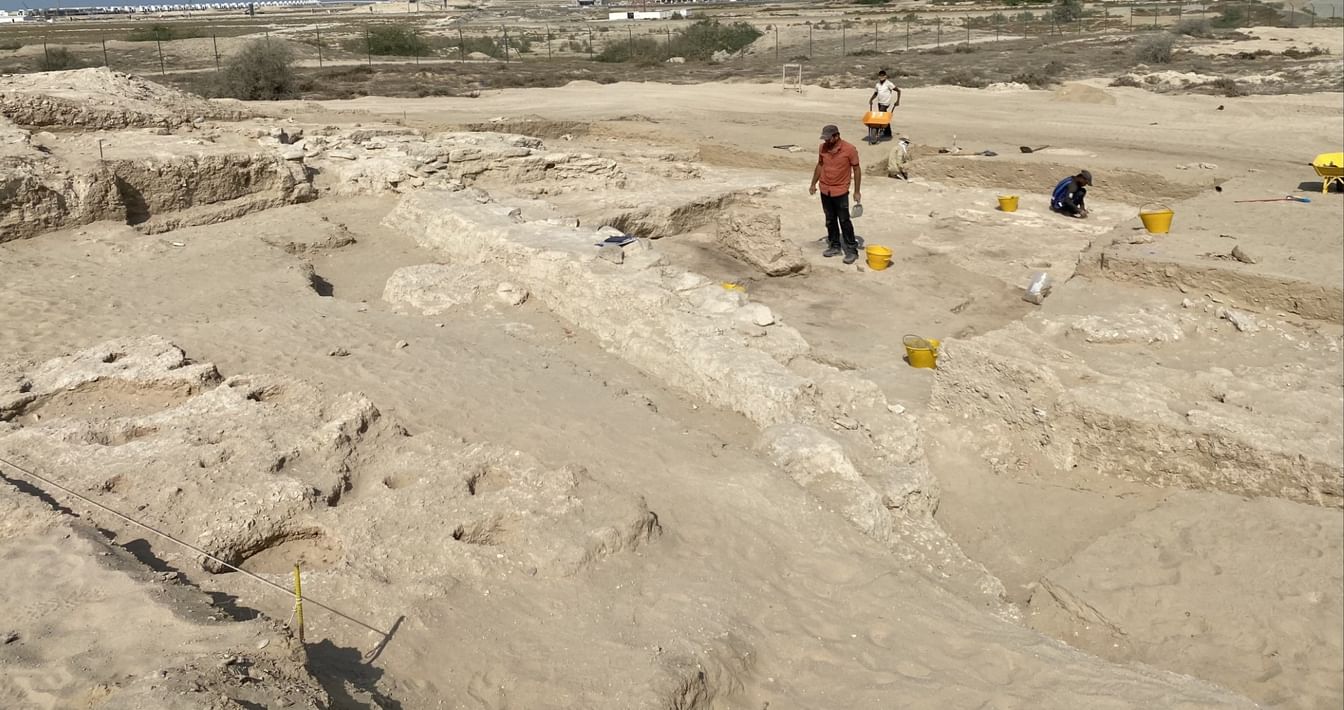

Dubai, UAE — Archaeological discoveries and scientific studies announced across the UAE during 2026 have opened new chapters in the country’s human history, settlement patterns and ancient economic life.
The findings, based on surveys, excavations and scientific research, offer new insight into how ancient communities adapted to environmental changes while maintaining regional connections.
In Sharjah, an international research project uncovered evidence of repeated early human occupation at the Jebel Al Buhais rock shelter across widely separated periods.
Published in Nature Communications in March, the study documented human presence dating from 60,000 to 16,000 years ago, providing evidence of adaptation to severe climate fluctuations and drought.
In July, the Department of Culture and Tourism – Abu Dhabi announced the discovery of a major tomb at the Qattara Archaeological Cemetery in Al Ain.
The tomb dates to the Wadi Suq and Late Bronze Age periods, roughly 2000 to 1300 BCE.
The remarkably preserved structure was built using carved stone blocks reused from earlier Umm al-Nar funerary structures dating to around 2700 to 2000 BCE.
Measuring 11 by 2.5 metres, the collective tomb was used by hundreds of people over at least a millennium. Excavations uncovered pottery, weapons and personal ornaments.
Human remains and artefacts are undergoing isotopic and DNA analysis to investigate ancient trade networks, diets, health and migration routes.
The discovery adds to Al Ain’s archaeological significance. Its cultural sites were inscribed on the UNESCO World Heritage list in 2011.
The UAE’s heritage received further international recognition in 2026 with the inscription of five Emirati sites on the Islamic World Educational, Scientific and Cultural Organization Heritage List.
The sites include Saruq Al Hadid in Dubai and four locations in Sharjah: Jebel Faya, the historical towers and forts of Khorfakkan, Nahwa and Wadi Al Helo.
Wadi Al Helo contains Bronze Age petroglyphs and historic village remains, while Nahwa features rock art dating from the Bronze Age to modern times and documented using 3D digital technology.
Jebel Faya has also entered a new phase of scientific research supported by an AED 2 million grant running from 2026 to 2028.
Together, the discoveries highlight the UAE’s efforts to combine excavation, restoration, digital documentation and international heritage registration to preserve and expand knowledge of its past.