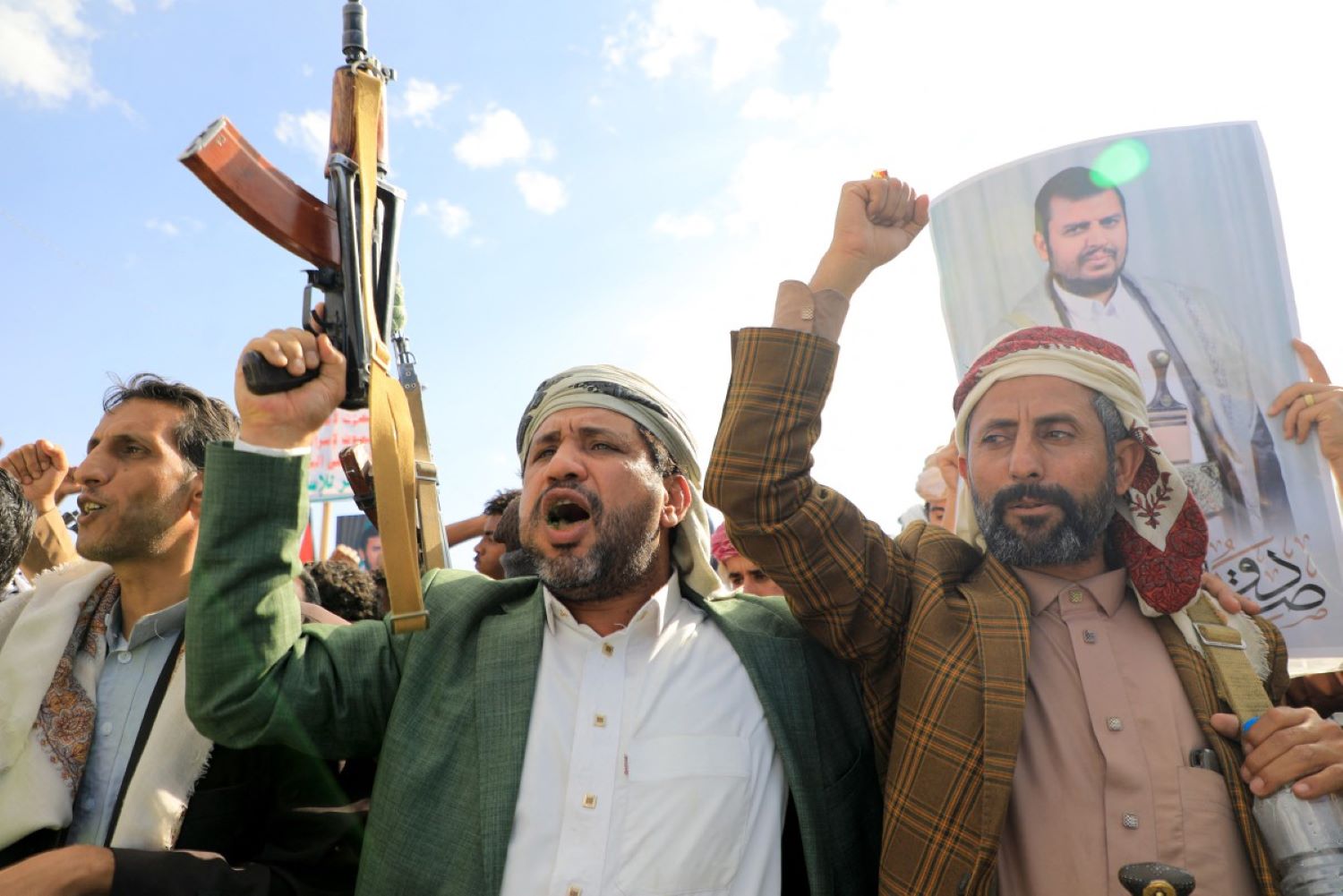

Yemen’s Houthis have rapidly expanded their control along the country’s Red Sea coast, seizing the strategic Mayyun Island in the Bab al-Mandab Strait and adding a new maritime dimension to the wider Iran war.
The Iran-aligned group’s advances have placed it in a position to influence one of the world’s most important shipping chokepoints, while attacks on Saudi energy infrastructure and tighter US measures around the Strait of Hormuz point to a conflict spreading across multiple regional fronts.
Iran’s Tasnim News Agency reported that the Houthis had taken control of the strategic Bab al-Mandab Strait after seizing Mayyun, also known as Perim, an island located at the centre of the waterway.
Two Yemeni sources also told Reuters that Saudi-backed Yemeni government forces had withdrawn from the island. The development followed the Houthi capture of the western coastal city of Mocha, forcing government forces to retreat towards the south and the city of Dhubab.
The Yemen Press Agency, citing field sources, reported that Houthi forces had also seized the al-Omari camp overlooking the strait.
Houthi military spokesman Yahya Saree was reported as saying maritime navigation in the Red Sea was safe except for Saudi ships, while vowing to escalate military action against Saudi forces until the blockade on Yemen ends.
A strategic maritime chokepoint
The Bab al-Mandab, known in Arabic as the “Gate of Tears”, links the Red Sea with the Gulf of Aden and the wider Indian Ocean. At its narrowest point, the strait is about 30 kilometres wide.
Its importance extends well beyond Yemen. The Red Sea connects European and Asian trade routes through the Suez Canal, allowing oil tankers and cargo ships to avoid the much longer journey around Africa.
The waterway has already experienced major disruption during the Gaza war, when repeated Houthi attacks on shipping sharply reduced traffic through the Suez Canal.
According to IMF PortWatch data analysed by AFP, total Suez Canal transits fell from 26,895 vessels in 2023 to 14,498 in 2024 and 14,070 in 2025.
The latest Houthi advances therefore come as global shipping remains sensitive to security risks around the Red Sea and Bab al-Mandab.
Iran’s Islamic Revolutionary Guard Corps has welcomed the developments. IRGC spokesman Sardar Mohebi described the Houthi advance as a “divine triumph” and the result of years of resistance by the group.
Iranian officials have continued to celebrate the gains. Mohammad Mokhber, an adviser to Iran’s supreme leader, said the “homegrown resolve” of resistance forces had driven the US and its allies into a tactical and strategic impasse.
The developments have also triggered a growing humanitarian toll. Nearly 500 Yemeni refugees, including women and children, arrived in Djibouti’s coastal city of Obock after being rescued from boats stranded without fuel.
The International Organization for Migration said at least 46,000 people had been displaced in Yemen since fighting escalated last week.
Saudi oil infrastructure comes under attack
The Houthi advance has coincided with attacks on Saudi Arabia, including strikes on the kingdom’s critical East-West oil pipeline.
Saudi Arabia said drones launched from Iraqi territory had attacked the pipeline, which runs from the kingdom’s oil-producing east to the Red Sea. The attacks resulted in injuries and damage, while Saudi authorities temporarily shut the pipeline.
Riyadh said it would not retaliate for now following a request from Iraq’s prime minister, but warned that it reserved the right to take necessary measures to protect its sovereignty, security and critical facilities.
Iraq subsequently ordered an investigation and said a military commander had been dismissed after investigations confirmed that the drones originated from Iraqi territory.
Iraq also closed the Shalamcheh border crossing with Iran as a precautionary measure, while security sources said a wider operation was under way to pursue those responsible for the attacks.
Saudi Arabia’s response has been closely watched by regional governments. Bahrain and the Muslim World League condemned the attacks, while Iraqi and Saudi foreign ministers spoke by telephone and stressed continued coordination.
Turkey’s foreign minister, Hakan Fidan, also discussed the attacks with his Saudi counterpart, Prince Faisal bin Farhan Al Saud. Turkey, Saudi Arabia and Pakistan signed a joint defence agreement last month containing a mutual defence clause.
Hormuz pressure deepens
At the other end of the regional maritime picture, the Strait of Hormuz remains under severe pressure.
Iranian Foreign Ministry spokesman Esmaeil Baghaei said the strait “remains and will remain” under Iran’s full control, blaming US actions for insecurity and higher global fuel prices.
The comments came as Washington tightened restrictions on shipping through the waterway. The US has asked tankers travelling through Hormuz to sail only during specified periods to receive military protection after Iran stepped up attacks on ships travelling at night.
The Financial Times reported that the protection window had been reduced to two specific daily time slots around the beginning of September. Washington has provided air-based defence since May for vessels using a route along the Omani side of the strait.
US Central Command said American forces had redirected 99 commercial vessels as of September 11 as part of an ongoing naval blockade of Iran.
The measures come as Iran and the US remain locked in a wider confrontation, with maritime restrictions adding pressure to already disrupted global energy and trade routes.
Trump predicts an end to the war
Despite the expanding geographic footprint of the conflict, US President Donald Trump said the war with Iran would end “very soon”.
Speaking in Dublin after meeting Irish President Catherine Connolly, Trump said the crisis surrounding shipping through the Strait of Hormuz would “work out just fine”.
He also said oil prices would fall sharply once the war ended.
Trump’s comments came against the backdrop of the Houthi advances in Yemen and reports of attacks near Saudi Arabia’s vital energy infrastructure, underscoring the gap between Washington’s prediction of a near-term end to the conflict and the increasingly complex security environment across the region.
Conflict spreads beyond the main fronts
The wider conflict is also affecting Lebanon and Syria.
Lebanese President Joseph Aoun visited Nabatieh in southern Lebanon near a strategic Hezbollah position destroyed by the Israeli army. He said there would be no new negotiations with Israel at present, while reiterating demands for the withdrawal of Israeli forces, the return of prisoners and displaced people, and reconstruction.
US-brokered talks between Israel and Lebanon originally scheduled for Rome next week have been postponed until October. Lebanese and Israeli ambassadors are instead due to meet at the US State Department in Washington to discuss developments and implementation of a framework agreement reached in June.
Israeli forces also shelled areas in southern Syria and opened fire towards civilian homes in western Daraa, according to Syria’s official SANA news agency.
The expanding fronts have raised concerns over the ability of governments and international organisations to contain the conflict.
Eritrean Foreign Minister Osman Saleh told Middle East Eye that there was no military solution to the Yemen conflict and that foreign powers could not “subdue” the Yemeni people.
With Yemen divided and the Houthis gaining ground around one of the world’s most important maritime passages, the conflict is increasingly tying together security risks in the Red Sea, Gulf and wider Middle East.
For shipping and energy markets, the developments put two critical waterways — Bab al-Mandab and Hormuz — at the centre of an increasingly interconnected regional crisis.