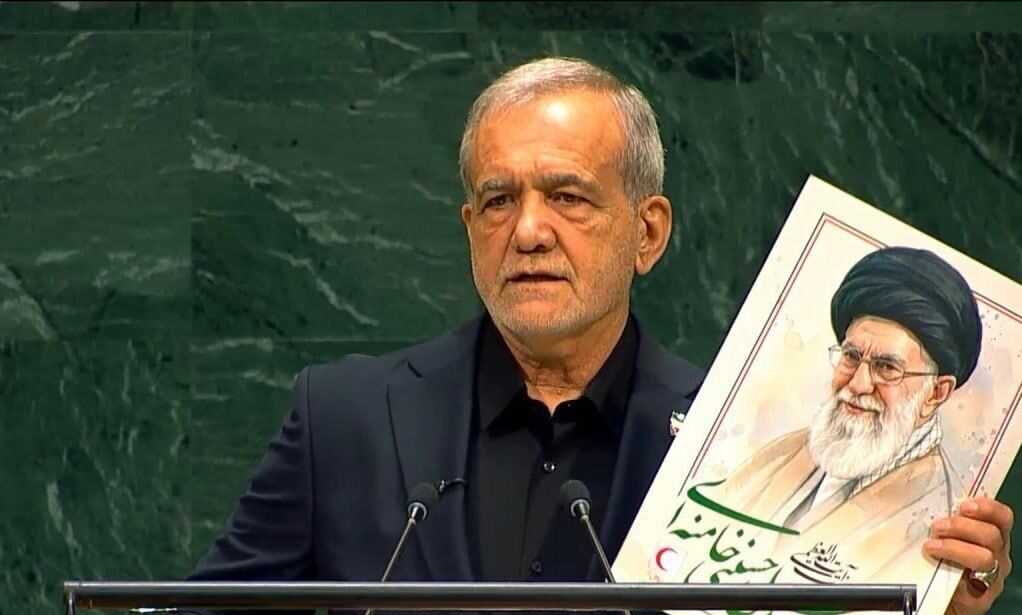

Iranian President Masoud Pezeshkian has rejected US pressure to surrender, while saying Tehran remains open to diplomacy to end the war with Washington.
Speaking at the United Nations General Assembly in New York, Pezeshkian delivered a defiant response a day after US President Donald Trump warned Iran that he faced a choice between a deal and annihilation.
Pezeshkian said Iran would continue defending itself against what he described as “cowardly” attacks. He said the US and Israel had imposed the war on Iran and that Tehran had demonstrated it was not afraid to defend itself.
The Iranian president also said threats would not force Tehran to yield, while leaving open the possibility of negotiations.
The US delegation walked out at the beginning of Pezeshkian’s speech.
HORMUZ CONDITIONS
The Strait of Hormuz remains central to the diplomatic effort, with Tehran continuing to tie its reopening to conditions involving US military pressure.
Iranian security chief Mohsen Rezaei said Tehran had given Washington five days to meet its conditions for reopening the strategic waterway.
The waterway has become a major flashpoint in the conflict, with shipping severely disrupted and governments warning of the wider economic consequences.
Iran has previously conveyed through mediators that it could reopen Hormuz within seven days if Washington eased military pressure and lifted its blockade of Iranian ports.
Iranian officials have also called for the release of frozen Iranian assets and an end to the war on what Tehran describes as resistance fronts.
DIPLOMACY CONTINUES
The latest developments came as Washington and Tehran continued diplomatic contacts through mediators.
US President Donald Trump said Iranian and US representatives had held a “very good” and “very productive” meeting at the UN and that another meeting was scheduled.
The contacts marked a revival of diplomacy after weeks of limited direct engagement. US special envoy Steve Witkoff and Jared Kushner were involved in the discussions on the US side, while Iranian Foreign Minister Abbas Araghchi represented Tehran in contacts with Washington through mediators.
Iranian officials have said their delegation has authority to pursue diplomacy, but Tehran has continued to insist that any agreement must address its conditions.
The diplomatic contacts have focused in particular on the reopening of Hormuz and the broader terms for ending hostilities.
US MAINTAINS PRESSURE
US officials have continued to combine diplomatic messaging with warnings that military options remain available.
US Secretary of State Marco Rubio said any agreement with Iran would require extensive negotiations, while the Trump administration has continued to press Tehran through economic measures.
US Treasury Secretary Scott Bessent outlined three possible outcomes from Washington’s pressure campaign: divisions within Iran’s leadership, an uprising by the Iranian people, or an agreement that Tehran would honour.
The United States has also imposed new aviation-related sanctions affecting Iranian carriers.
FLIGHTS DISRUPTED
New US aviation sanctions have disrupted Iranian air travel, with airlines and neighbouring countries cutting services to Iranian carriers.
Nearly all Iranian flights to Turkiye, the UAE and China have been cancelled following the end of a short wind-down period that had allowed countries to continue servicing Iranian airlines.
Oman, Azerbaijan and Georgia have also stopped providing airspace and airport services to Iranian carriers, while Baghdad’s airport is no longer available to them, although flights to Najaf continue.
The disruption has pushed travellers towards land crossings, with congestion reported at Iran’s borders with Turkiye and along routes to Armenia.
OIL MARKETS WATCH TALKS
Oil prices edged lower after Iran signalled that it remained open to diplomacy.
Brent crude futures fell 94 cents, or 0.9 percent, to $102.13 a barrel, while US West Texas Intermediate crude fell 59 cents, or 0.7 percent, to $91.56.
The declines followed a 4 percent rise in the previous session as markets responded to signs of possible diplomatic progress.
Hormuz remains critical to global energy markets, making any agreement over the waterway a key factor for oil supply and prices.
REGIONAL PRESSURE
European Council President Antonio Costa said he had held a “frank and substantial discussion” with Pezeshkian.
Costa called for dialogue, an end to Iranian strikes against neighbouring countries and the restoration of freedom of navigation through Hormuz. He also urged Tehran to resume cooperation with the International Atomic Energy Agency.
Meanwhile, an Iranian foreign ministry spokesperson criticised Canadian Prime Minister Mark Carney over comments describing threats against Iran as “language of war”.
Iran’s military has separately warned that it is prepared to respond to further attacks, underscoring the gap between the diplomatic contacts and the continuing confrontation.