
Qatar has warned that the continued disruption of the Strait of Hormuz could trigger an “industrial catastrophe”, as the Gulf state called reopening the vital waterway a priority.
Qatar’s Foreign Ministry spokesperson Mohammed Al-Ansari told US media that restoring navigation through the strait was an urgent priority as the regional crisis continues.
The warning comes as shipping traffic through the waterway has fallen sharply. An average of just 10 commodity ships transited the strait each day over the past 10 days, the lowest level since May, according to Kpler data.
The slowdown follows US and Iranian strikes on tankers and mounting tensions over navigation through one of the world’s most important energy chokepoints.
Iran threatens tighter restrictions
Iran has threatened to impose further restrictions around the Gulf and the Strait of Hormuz in response to US economic sanctions.
Iran’s top security official Mohsen Rezaei said Tehran was preparing to enforce a restricted zone across the Gulf and threatened a full blockade in and around the strait.
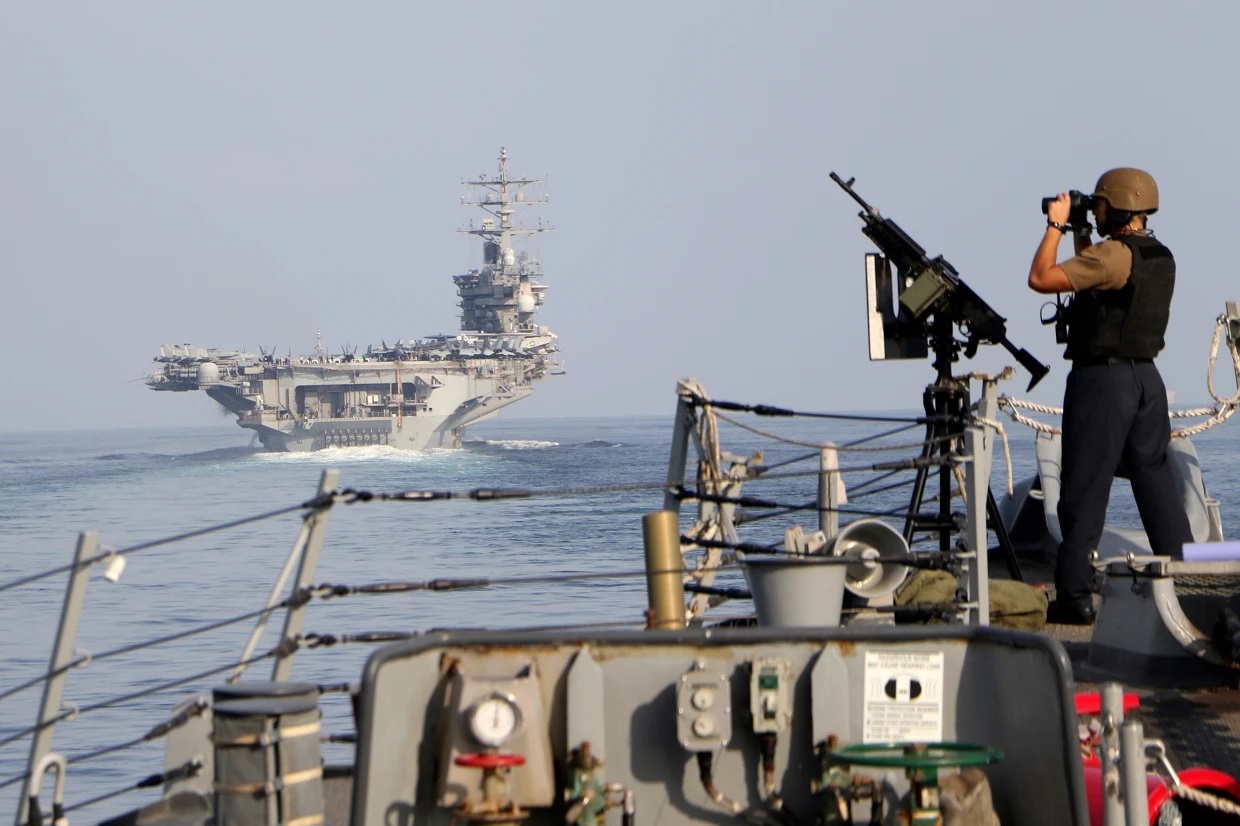
Iran’s acting defence minister, Brigadier General Majid Ibn Reza, meanwhile said Tehran had the technical capability to target US warships enforcing Washington’s blockade of Iranian ports.
The United States has said it will take “decisive measures” against Iran’s disruption of navigation, while US Central Command says it has redirected 94 commercial vessels, disabled three and boarded two since mid-July.
Oil markets price in prolonged disruption
Oil prices have continued to rise as traders factor in the risk of a prolonged conflict and further disruption to supplies.
Brent crude rose to $97.34 a barrel, while US West Texas Intermediate was at $92.63, with Brent reaching its highest level since July 24 in the previous session.
US President Donald Trump has nevertheless said oil prices will fall sharply after what he described as a US victory over Iran, predicting US pump prices could eventually fall below $2 a gallon.
Iraq seeks routes around Hormuz
Iraq is looking to shift oil exports away from the Strait of Hormuz as the disruption threatens a key source of government revenue.
Iraq exported about 3.4 million barrels of crude per day before the US-Israel war on Iran, with roughly 80 to 85 percent of those exports moving directly through Hormuz.
Government adviser Mazhar Muhammad Salih said Baghdad was pursuing alternative pipelines and transit routes to protect oil exports from geopolitical disruption.
Yemen fighting intensifies
Yemen is emerging as another major regional pressure point, with fighting between the internationally recognized government and the Houthis intensifying in Taiz and al-Jawf.
The World Health Organization says the fighting has killed or wounded nearly 900 people, while about 20,000 people and families have been displaced in Taiz.
The government has opened a new front in al-Jawf as it seeks to regain territory, while the Houthis are pushing for control of Taiz and the Red Sea port city of al-Makha.
Lebanon remains another flashpoint
Israeli attacks in Lebanon have killed 4,362 people and wounded 12,378 since March 2, according to Lebanon’s Health Ministry.
The ministry said the total toll since October 2023 had reached 8,929 killed and 30,614 wounded.
The Israeli military says it has established “operational control” over strategic high ground in southern Lebanon and has accused Hezbollah of launching armed drones at its forces. Hezbollah has not commented on the accusation.
Nuclear tensions add to regional risks
The International Atomic Energy Agency is pressing Iran to re-engage with the nuclear watchdog as the United States, Britain, France and Germany seek a resolution that could refer Tehran to the UN Security Council.
Iranian Foreign Ministry spokesperson Esmaeil Baghaei has warned that Tehran would respond if the IAEA adopts a resolution against it.
The overlapping disputes over Iran’s nuclear programme, sanctions and navigation through Hormuz are adding another layer of uncertainty to an already widening regional crisis.