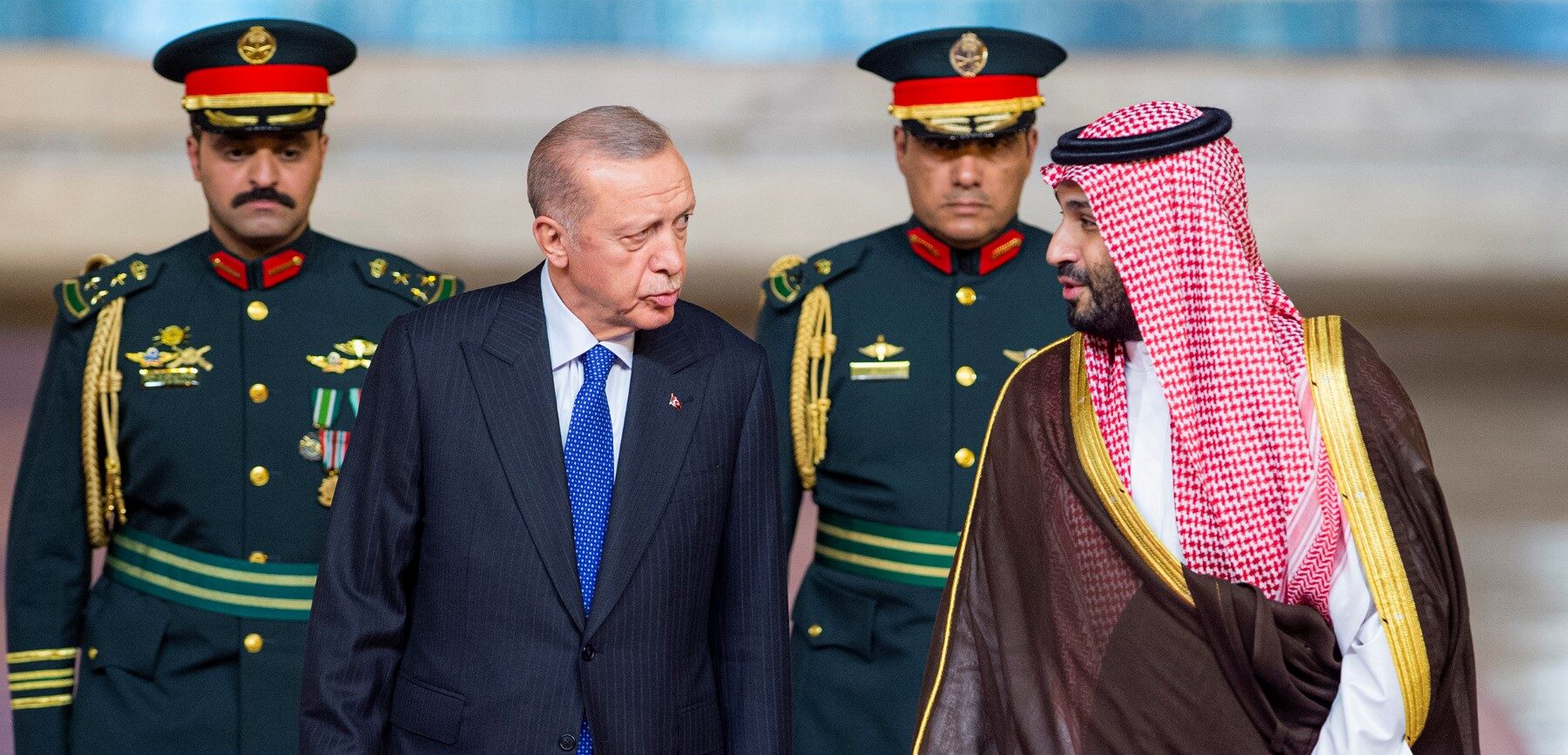

Chiefs of staff from Saudi Arabia, Türkiye and Pakistan are preparing to hold an urgent military meeting following recent Houthi attacks on Saudi Arabia, according to a statement by the Saudi Ministry of Foreign Affairs.
The talks are being organised under the Mecca Joint Defence Agreement, which was signed by Saudi Arabia, Türkiye and Pakistan and stipulates that “any attack on any party is considered an attack on all parties”.
The announcement followed a high-level meeting on Thursday at Saudi Arabia’s Permanent Delegation to the United Nations in New York, where Saudi Foreign Minister Prince Faisal bin Farhan Al Saud met with Pakistan’s Deputy Prime Minister and Minister of Foreign Affairs Mohammad Ishaq Dar and Turkish Foreign Minister Hakan Fidan.
During the meeting on the sidelines of the United Nations General Assembly, the ministers strongly condemned what they described as “vicious attacks targeting Mecca as well as civilian and economic facilities in Saudi Arabia”.
They praised the vigilance of the Saudi armed forces and affirmed the kingdom’s right to defend its security in accordance with Article 51 of the United Nations Charter.
The ministers also discussed regional stability, emphasising the importance of international law, good neighbourliness and ensuring freedom of maritime navigation. They renewed their commitment to de-escalation and peaceful solutions.
UAE halts Iranian airline flights
The United Arab Emirates has suspended flights operated by Iranian airlines, joining several other countries that have restricted Iranian carriers amid the enforcement of new US sanctions.
The UAE’s General Civil Aviation Authority announced the “suspension of all flights operated by Iranian airlines to and from the UAE”, according to a statement carried by the Emirati state news agency WAM.
The decision was based on US sanctions imposed on Iranian airlines, which prevent them from using airports around the world.
The UAE has joined Oman, Iraq, Azerbaijan, Georgia and Turkmenistan in restricting or suspending access for Iranian airlines amid the enforcement of the new US sanctions.
Dubai, the UAE’s commercial hub, is a major destination for Iranian carriers, with multiple daily flights, a large Iranian community and close business links.
Pezeshkian says Iran remains open to agreement
Iranian President Masoud Pezeshkian has told US media that Tehran remains willing to pursue an agreement with Washington through negotiations, despite what he described as the “assassination” of Iran’s supreme leader, scientists and military commanders.
In an interview with Fox News, Pezeshkian said discussions and negotiations were within the framework of international law and that Iran was seeking an agreement if the United States agreed to it.
He said Iran had previously reached an agreement with US President Donald Trump and remained willing to move forward on that basis.
Pezeshkian also said Iran had not closed the Strait of Hormuz and that it had remained open without what he described as legal justification or a framework for its closure.
Russia and Iran call for diplomatic settlement
Russian Foreign Minister Sergey Lavrov met Iranian Foreign Minister Abbas Araghchi in New York on the sidelines of the UN General Assembly to discuss regional and international issues, with a focus on developments surrounding Iran.
The two ministers also discussed implementation of bilateral agreements reached by the Russian and Iranian presidents earlier this month.
According to the Russian Foreign Ministry, the two sides stressed that a diplomatic settlement was the only way to end tensions in the Middle East.
They said there was no alternative to a diplomatic settlement of what the ministry described as a crisis caused by the “unlawful actions” of the United States and Israel.
Britain urges Iran to de-escalate
British Foreign Secretary Ed Miliband also met Araghchi on the sidelines of the UN General Assembly.
Miliband discussed the importance of reopening the Strait of Hormuz and what Britain described as its resolve to combat threats from Iranian-linked groups on British soil, including attacks on the British Jewish community.
According to the British Foreign Office, Miliband told Araghchi that Iran should choose de-escalation and diplomacy rather than prolonging the war.
He also stressed the importance of restoring freedom of navigation and fully reopening the Strait of Hormuz, citing the impact of continued disruption on global security and economic stability.
Oil prices ease as markets weigh truce hopes
Oil prices edged lower as markets weighed the possibility of a truce between the United States and Iran against Houthi attacks on Saudi Arabia following a week of price volatility.
Brent crude was down 74 cents, or 0.69 percent, at $105.85 a barrel as of 00:32 GMT, while West Texas Intermediate was down 81 cents, or 0.86 percent, at $93.80.
The softer opening followed a volatile week in which both contracts rose as much as 5 percent on Thursday. Brent settled 3.4 percent higher, while WTI gained 2.7 percent.
Brent recorded its highest close since September 15. It was WTI’s first daily rise in several sessions, although the contract had fallen 13 percent over the previous six sessions.