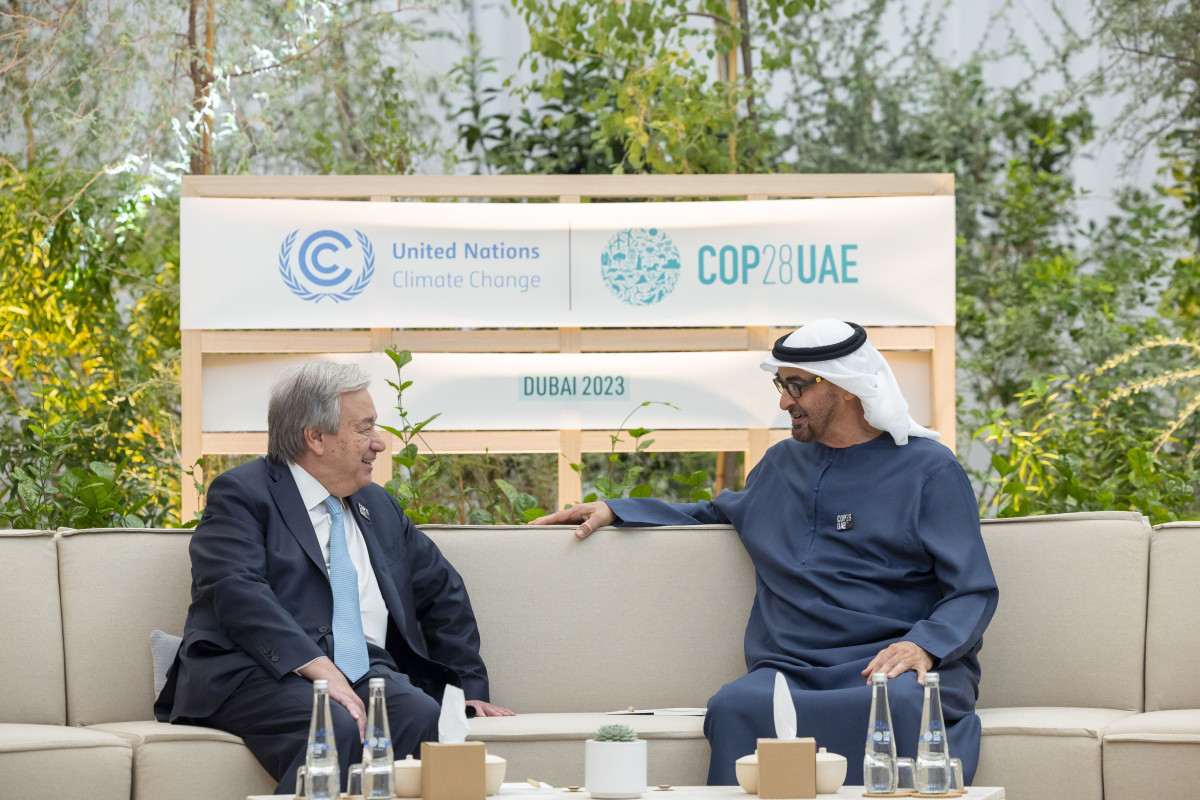

Dubai, UAE— UAE President Sheikh Mohamed bin Zayed and UN Secretary General António Guterres discussed the importance of the conference in enhancing international collective action to address climate challenges in a manner that serves humanity and future generations.
The meeting between the two took place at the ongoing UN Climate Change Conference (COP28) in Expo City Dubai.
The UN Secretary-General commended the initiative by His Highness Sheikh Mohamed bin Zayed Al Nahyan in establishing a US$30 billion fund for global climate solutions to bridge the climate financing gap and facilitate affordable access.
The meeting also addressed cooperation between the UAE and UN agencies, particularly in supporting world peace, climate action, and sustainable development, as well as humanitarian work regionally and internationally.
Additionally, both sides reviewed a number of regional and international issues of mutual interest, with particular emphasis on developments in the Occupied Palestinian Territory.
They underscored the need for international action to reach a ceasefire in the Gaza Strip, protect civilians, prevent their forced displacement, and ensure the safe, sustained, and at-scale delivery of humanitarian aid.
Furthermore, efforts to prevent the escalation of regional conflict and work towards peace based on the two-state solution were discussed as essential for achieving regional stability, creating an environment conducive to enhanced cooperation in the Middle East, and fostering the development and prosperity of its peoples.