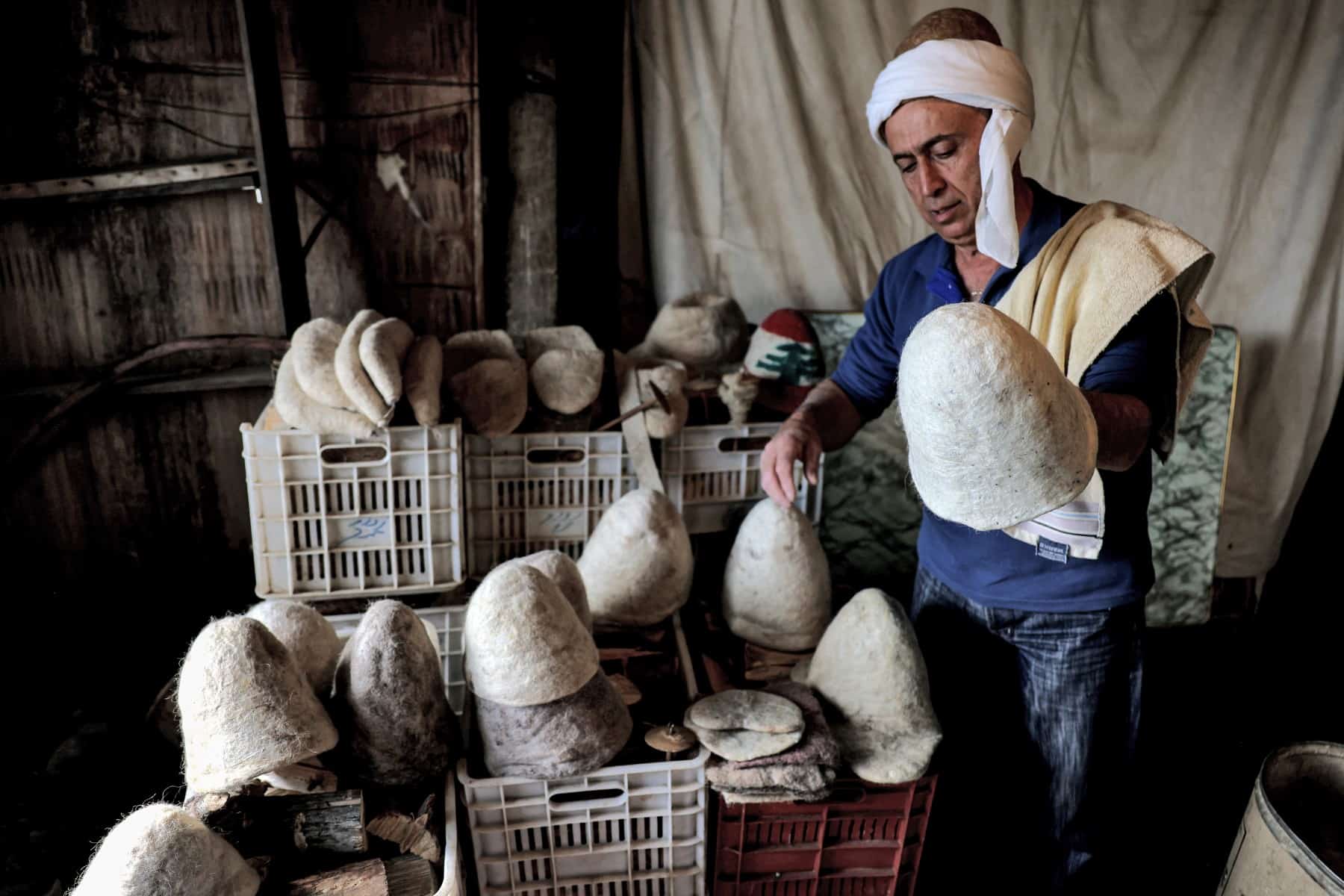

Hrajel, Lebanon—High in Lebanon’s rugged mountains, hatmaker Youssef Akiki is among the last artisans practicing the thousand-year-old skill of making traditional warm woolen caps once widely worn against the icy winter chill.
Akiki believes he may be the last commercial maker of the sheep wool “colored” — a named derived from the Arabic for felt, or “labd” — a waterproof and warm cap colored off-white, grey, brown or black.
“The elders of the village make their own labbadehs”, said Akiki, who also dresses in the traditional style of baggy trousers.
Akiki, 60, from the snow-covered village of Hrajel, perched more than 1,200 meters (4,000 feet) up in the hills back from Lebanon’s Mediterranean coast, said making the hat requires a careful process.
After drying sheep’s wool in the sun, he moulds it with water and Aleppo soap — which includes olive oil and laurel leaf extracts — to turn it into felt with his hands.
“It helps the wool shrink, so it becomes malleable like dough”, he said, showing his hands, rough with years of work.
It is a slow process that allows him to fashion “three labbadehs in one day, at most”, he said.
Though the hats are practical and warm, few people wear them today.
Those buying the caps are mainly tourists — or Lebanese nostalgic for their childhood — and they often buy them not to wear them but to display them at home.
“The state should guarantee us markets and places to exhibit,” the craftsman said.
Income from the hat trade is not enough to survive on, and Akiki also works as a farmer, especially given the dire economic crisis that has gripped Lebanon in recent years.
Lebanon’s economic turmoil has left many struggling to make ends meet, and the poverty rate has reached 80 percent of the population, according to the United Nations.
Akiki believes the labbadeh design is rooted in the caps worn by the ancient Phoenicians, although their style was “more elongated”.
Today, in order to encourage more customers, he is dabbling with more modern designs and, to keep the skills alive, is training his nephews in the time-honored craft.