This is a temporary backup site for TRENDS MENA while our primary website is being restored following a regional disruption affecting Amazon Web Services cloud infrastructure in the GCC.

Search Site

Alujain widens 2025 loss

The increase in loss is due to impairment charges, weaker prices.

Masar 2025 net profit $262m

Higher land plot sales boost revenue and operating income.

Tasnee’s 2025 losses deepen

The petrochemicals' company's revenue also fell 17.7 percent.

DP World 2025 revenue $24.4bn

The profit for the year up 32.2% to reach $1.96bn.

BYD 2025 revenue surges

The EV manufacturer reported net profit of $.3.3bn for 9M 2025.

13 countries to join new Asia-Pacific trade framework: Biden

  • Joe Biden will make a formal rollout of IPEF later Monday with 13 countries joining the initiative which aims to offer US allies an alternative to China in Asia-Pacific
  • China has criticized IPEF as an attempt to create a closed club. Biden's national security advisor rejected the claim saying that, "it is an open platform"
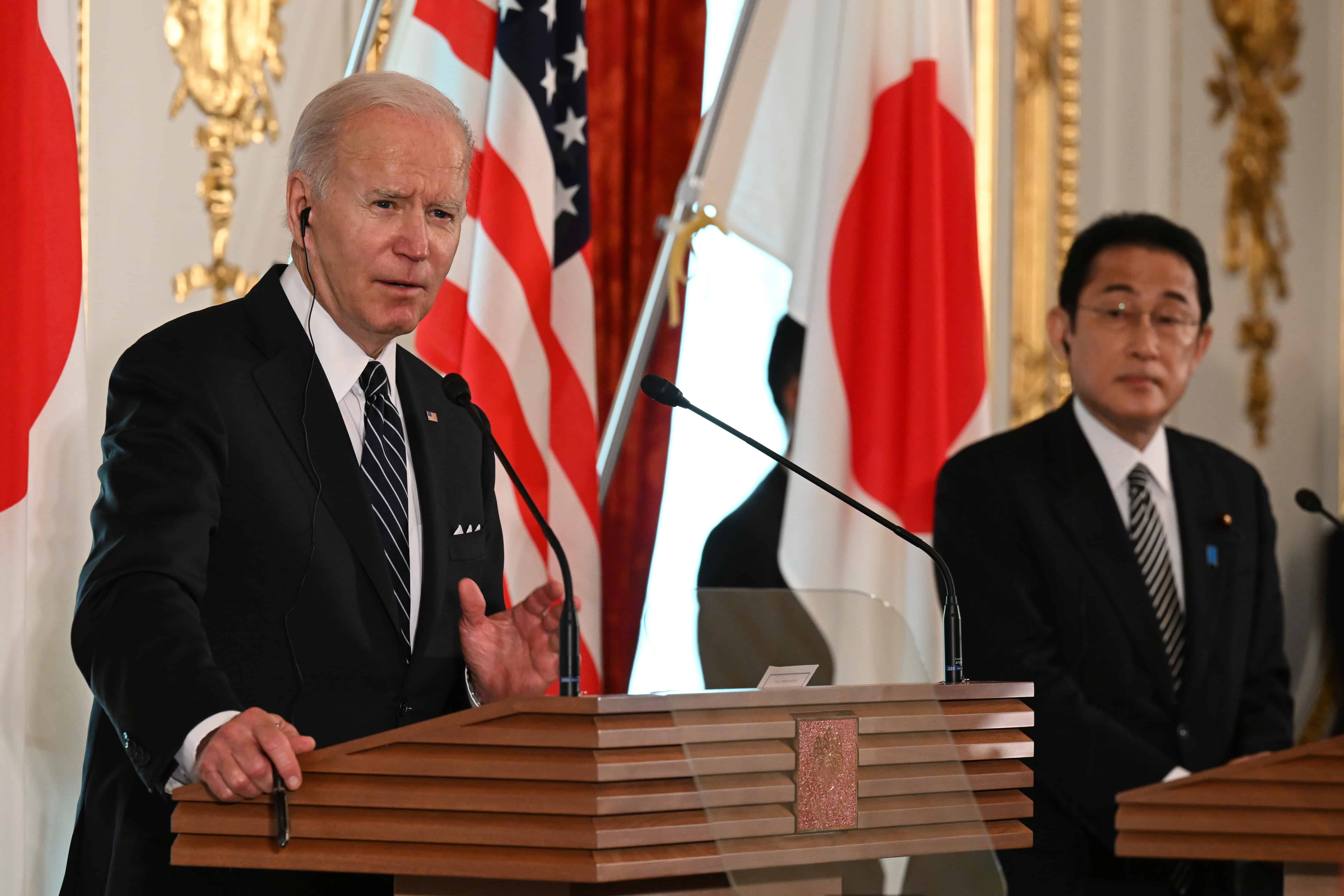
President Joe Biden announced Monday in Tokyo that 13 countries have joined a new, US-led Asia-Pacific trade initiative touted as a counterweight to China’s aggressive expansion in the region.
“The United States and Japan, together with 11 other nations will be launching” the Indo-Pacific Economic Framework for Prosperity, or IPEF, Biden said at a press conference alongside Japanese Prime Minister Fumio Kishida.”This framework is a commitment to working with our close friends and partners in the region on challenges that matter most to ensuring economic competitiveness in the 21st century,” he said.Biden was due to make a formal rollout of the framework later Monday.

He did not say what countries had already signed up to IPEF, which the White House is billing as a framework for what will ultimately become a tight-knit group of trading nations.

Unlike traditional trade blocs, there is no plan for IPEF members to negotiate tariffs and ease market access a tool that has become increasingly unpalatable to US voters fearful of undermining homegrown manufacturing.
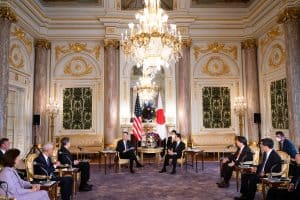
US President Joe Biden (center L) and Japanese Prime Minister Fumio Kishida (center R) attend a meeting at the Akasaka Palace State Guest House in Tokyo on May 23, 2022. (AFP)

Instead, the program foresees integrating partners through agreed standards in four main areas: the digital economy, supply chains, clean energy infrastructure and anti-corruption measures.

Biden has pushed to rapidly rebuild strategic military and trade alliances weakened under his predecessor Donald Trump since taking office in 2021.

And IPEF is intended to offer US allies an alternative to China’s growing commercial presence across the Asia-Pacific.

However, there is no political will in Washington for returning to a tariffs-based Asia trade deal following Trump’s 2017 withdrawal from the Trans-Pacific Partnership a huge trading bloc that was revived, without US membership, in 2018 as the Comprehensive and Progressive Agreement for Trans-Pacific Partnership.

China has criticized IPEF as an attempt to create a closed club. Biden’s national security advisor, Jake Sullivan, rejected this, telling reporters “it is by design and definition an open platform”.

Sullivan said that Taiwan, a self-governing democracy that China claims sovereignty over, has not been brought into the initial line-up despite being an important link in microchip supply chains.

Sullivan said nevertheless that the United States is “looking to deepen our economic partnership with Taiwan, including on high-technology issues, including on semiconductors and supply chains.”

This will happen, however, only “on a bilateral basis”.